
My business proposal
From the research I’ve done so far I’ve realised it’s not all entirely applicable to my business plan due to a few things:
• My business is a collective
• My business has been running for many years and is not in need of start-up loans or financial set up fees
• My business will already have clients and experience
Essentially I am answering three things:
• Information about my company and why we are the best
• Demonstrated knowledge of the problem
• How I’m going to solve the problem
• Pricing and methodology
Final PDF
My final 3000 words:
• Analytics (weekly reporting)
• Promotion and advertising
• Event press release
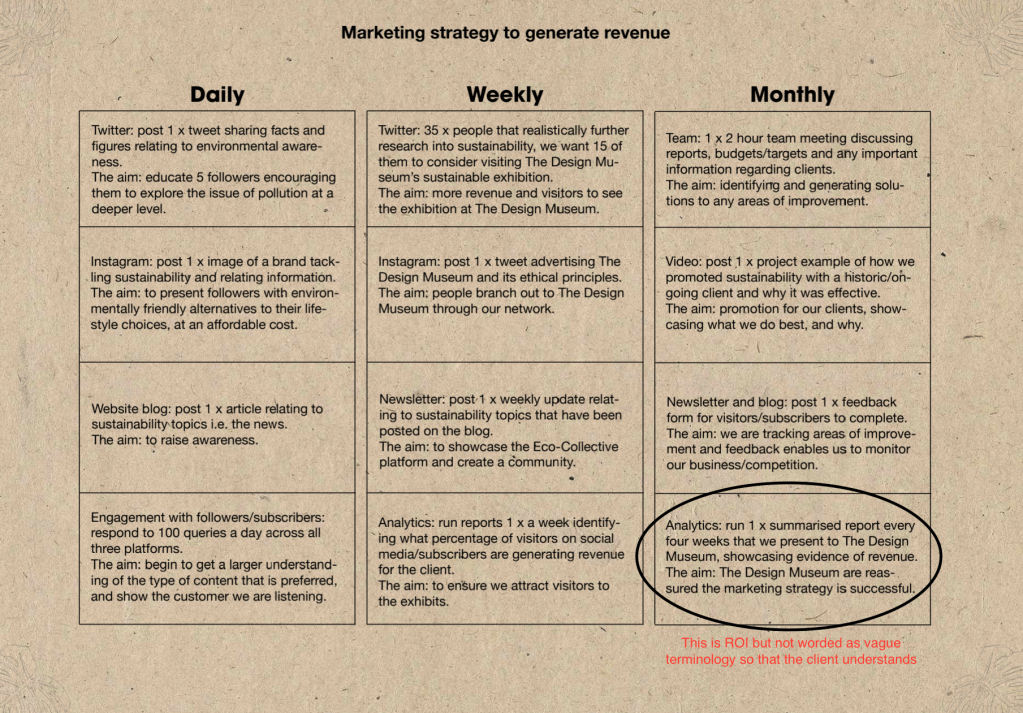
In the marketing section above I have tried to use simple terminology and avoid using abbreviated marketing terms (such as ROI which I mentioned in the references materials) in order to make the business plan understandable to the client. Also as this plan is also brief compared with that of a 10,000 word plan, I didn’t feel it would be right to bombard the client with lots of specific data information so early on in the process. This document for me is like a mini overview of each area we would consider as an Eco-Collective.
My summary:
I have learnt an incredible amount of information this week when creating the business plan. I have had insight to copyright principles, budgeting and marketing strategies which prior to this week, I had very little knowledge of. I now understand the importance of each category I have researched in my business plan and how to present this knowledge to appeal to clients.
Overall, I believe that there is a well executed business plan being presented to the client – The Design Museum. To look at it from a client perspective, I would want to know the basics behind the execution of the exhibition, such as costings and why my business should consider Eco-Collective for the project. Therefore I have highlighted areas which the collective business will excel over other potential suitors, such as offering a range of marketing services at an additional cost. This allows the client to have a customised experience as they can pick and choose elements in the exhibition journey. As Eco-Collective are an entirely sustainable company I have also included insights into sourcing materials, and how we generate an exhibit that can educate and change the perspective of a consumer.
To improve, I have used black ink throughout the business plan as I initially thought it would be the environmentally friendly option. However, from my research (and personal interest) I have now explored the use of natural inks and dyes and I now understand it is entirely possible to use coloured ink sustainably. Therefore, I would introduce that into my final business plan layout.
I have incorporated an ink brush into the pages to represent the natural dye stains that tea would make on the pages that introduce and summarise the business plan (I talked about this in my crit document):
I have selected cardboard as the texture background as it’s a material that is widely recycled, biodegradable and can be up-cycled. It’s also a shifting material in terms of texture as it can be rigid when dry but decompose when wet. I felt having this as a background theme throughout would instantly provide a suggestion of sustainability within Eco-Collective as an environmentally conscious collective.
 jesswhatley.design.blog