
Reference Material
Service design 101
I had a brief introduction to service design with this short article as wanted to understand the very basics before I began reading in-depth research:
Conventional mode:
– Following tradition and doing things the same way they have always been done is not effective in the long term. It limits and restricts creative processes
– Much more common through the middle ages
Design mode:
– Critical sense: ability to recognise what is and is not acceptable
– Creativity: ability to imagine fiction
– Practical sense: ability to recognise realistic processes
– Started to rise from the renaissance and scientific revolution; sociocultural, economic and technological change and therefore is not specific just to graphic design. It is suitable for individuals or businesses entirely, which keeps ideas fresh and innovative
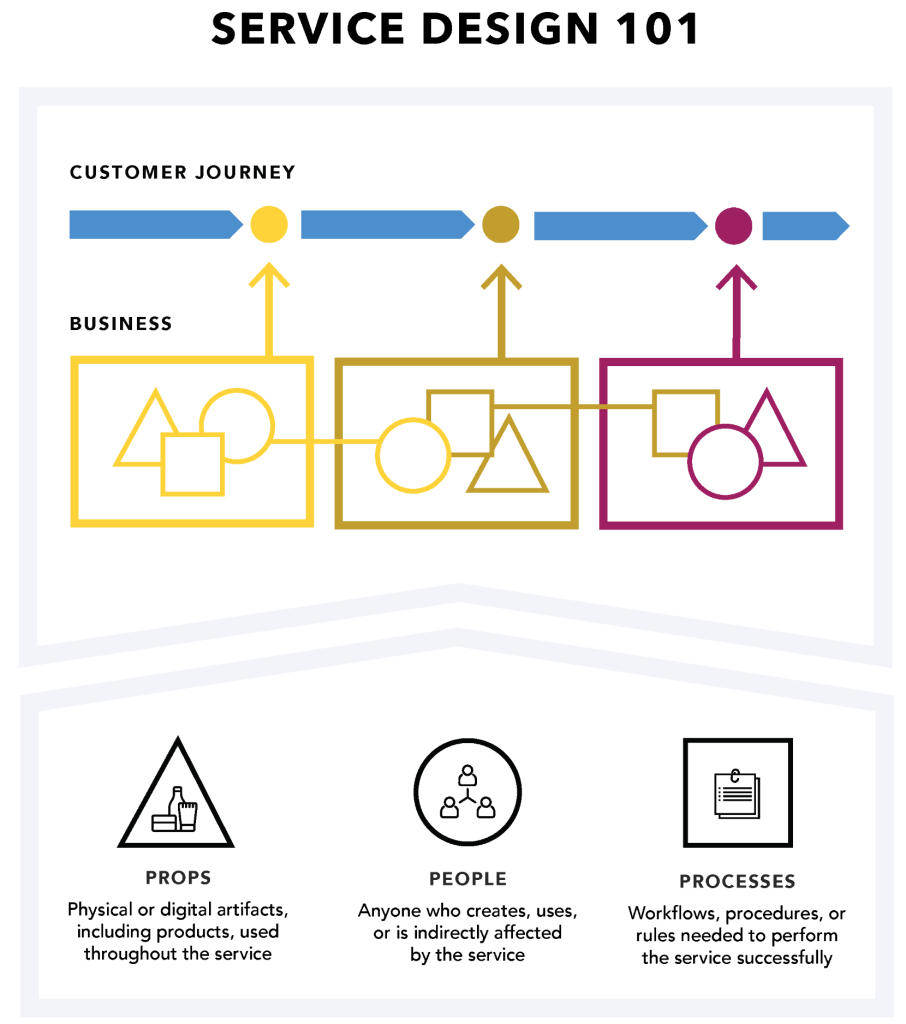

The screenshots from the article on NNGroup are a great introduction for me to understand how service design is beneficial to the overall design and how a service needs to be systematically arranged to be from various perspectives; for instance ‘front stage’ journey would be what the customer and users will experience whether that is products or touch points, whereas the ‘back stage’ design would be all of the workflows and tools to enable that user experience to run smoothly (your systems, employees etc).
This is Service Design Thinking: Basics, Tools, Cases
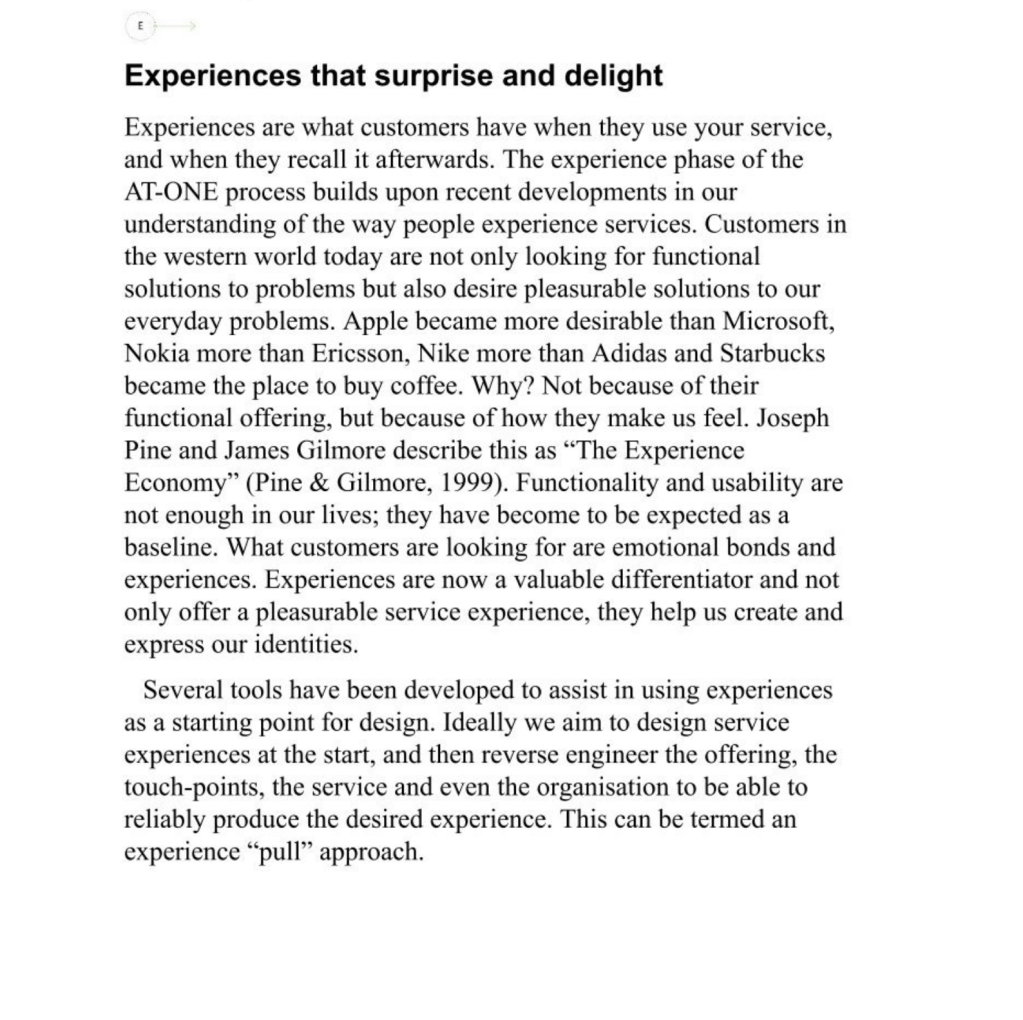
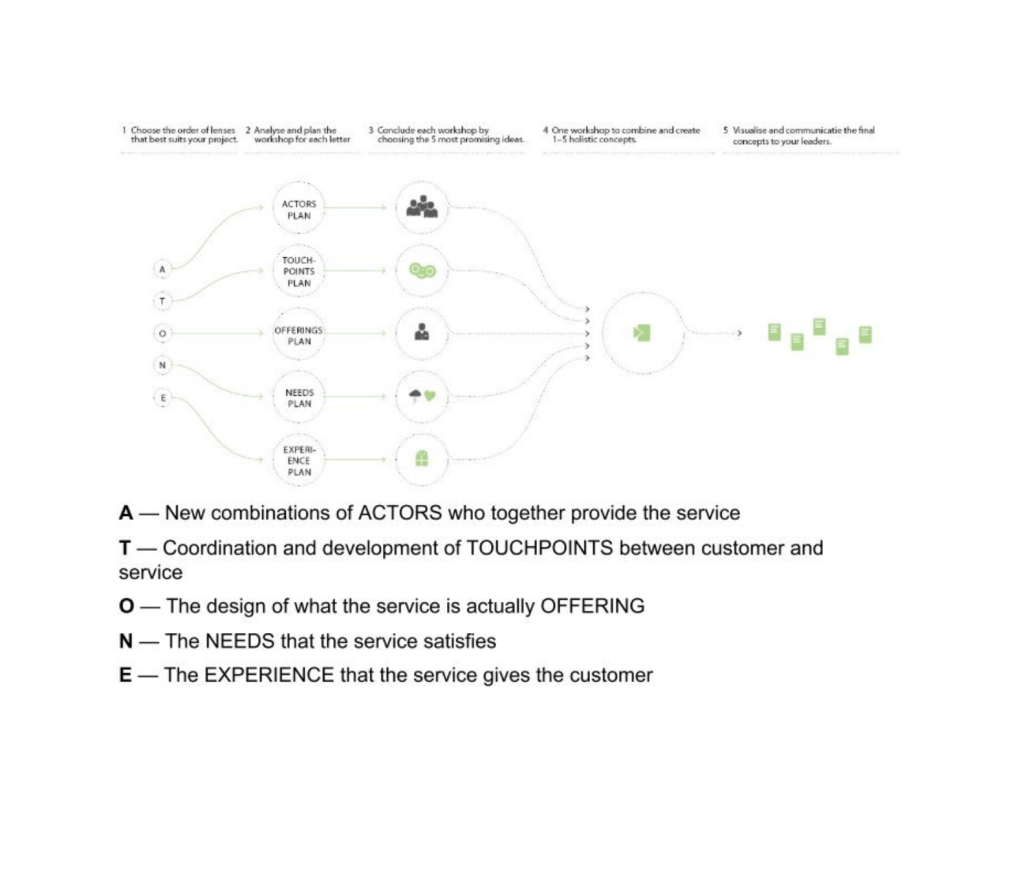
AT-ONE is a really great insight to consider when designing a service. Reading about how brands have been able to excel above competitors on the market by offering a very similar service (i.e. coffee!), but with a much more comprehensive service design process gives them that leverage for customers to choose their service over others. For example, Starbucks have more selection on their menu with experimental flavours for their drinks than Costa. Initially, Costa didn’t serve snacks but Starbucks did. Starbucks was also the first to make the leap at online ordering through an app… But they both do this now. I know that Starbucks also have more merchandise in shops and sell coffee mugs and gift sets in department stores which would also expand their brand. Companies are always having to think of the next innovative step to stay ahead, but it all comes down to reputation and service as companies will copy and try to match their competitors. The fundamental thing I am learning through this example is that service design isn’t something that is considered once, it’s a constantly evolving process which actually grows with the company to stay at the top of the consumer market.
How does service design work? (pg. 93)
“Understand the culture and goals of the company providing a service. Do they understand what service design thinking is? Is the company prepared for such a process? Since a service design process commonly involves co-creativity, it is important to agree on the extent to which the service designer has sovereignty within the creative process. Furthermore, the process starts by identifying a problem a service designer should work on; this problem is usually an organisational one or it is initially viewed from the organisational perspective. It is important to understand the company’s point of view on a certain problem, and in fact it could be argued that much of a service designer’s role is in articulating the organisational problem from the perspective of the customer. The second task is not finding a solution, but identifying the real problem. Gaining a clear understanding of the situation from the perspective of current and potential customers of a certain service is crucial for succesful service design. Again, it is important to keep the big picture and as far as possible ascertain the true motivations behind customer behaviour. To this end, it is important to look for insights beyond simply gathering of empirical data. Service design uses a vast collection of methods and tools from various disciplines to explore and understand the behaviour and mindset of all people involved. Ethnographic approaches from the social sciences have thus been adopted as one of the most commonly employed research approaches in the design of services. The third task is to visualise these findings and as far as possible the underlying structure of the previously intangible services. This helps simplify complex and intangible processes and promotes a sense within the design team and amongst the service stakeholders that is is possible to change aspects of the service proposition that might not appear to be functioning appropriately. Again, there are numerous methods and tools from various disciplines that can be adopted to assist this.“
From reading the above, I have highlighted the most important stages, but I want to know more about what an Ethnographic approach is? According to thoughtco: “As a method, ethnographic observation involves embedding oneself deeply and over the long-term in a field site of study in order to systemically document the everyday lives, behaviors, and interactions of a community of people.” It seems that Ethnographic research is a fundamental part of service design as it enables the designers to consider form and function for its appropriate user. By knowing more detail such as their hobbies, their familiarities with tools and systems etc. on a day to day basis will enhance the final outcome.
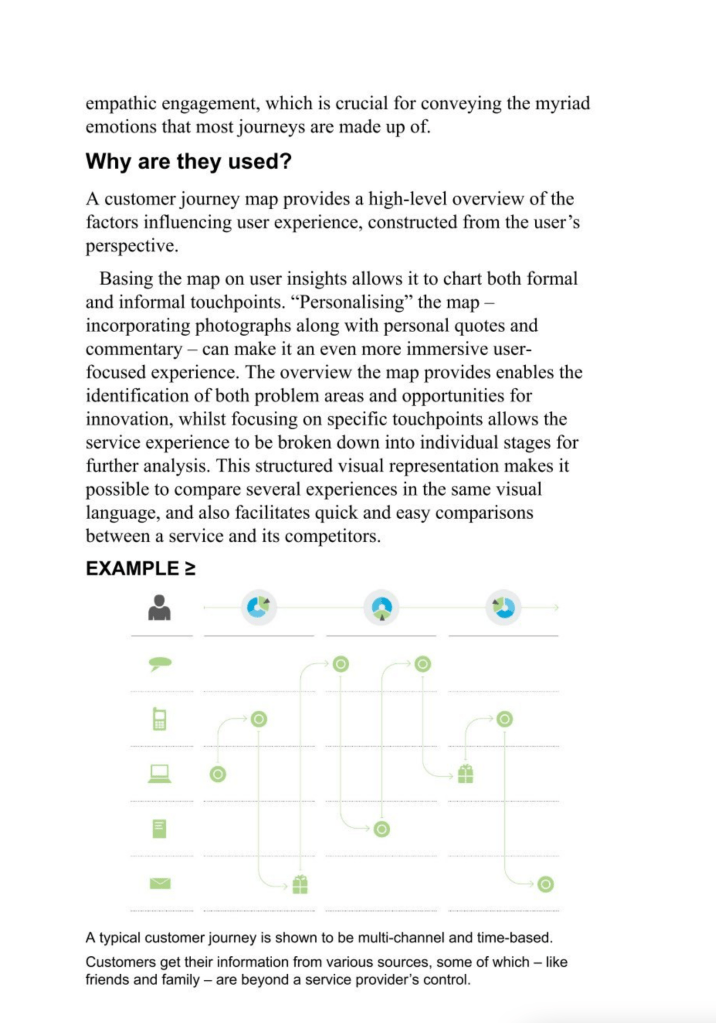
Customer journey mapping 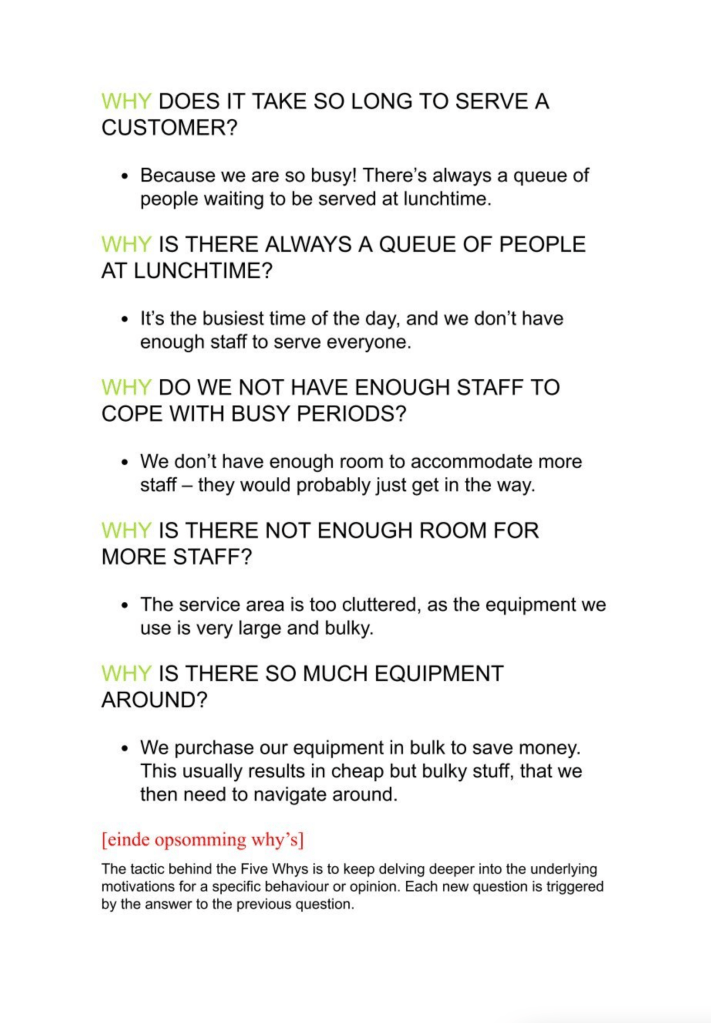
The 5 why’s 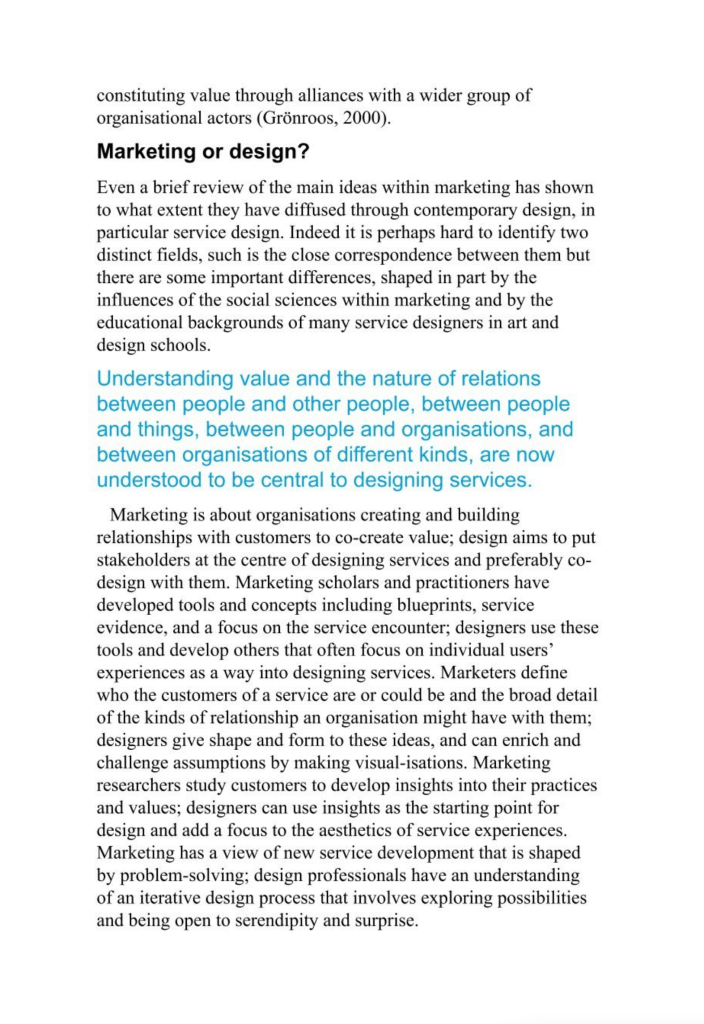
Marketing and design differentiation
The three screenshots of the pages above have stood out to me for various reasons such as below:
Customer journey mapping: this process enables designers to visualise the user at each stage of their journey. This is beneficial as this diagram can identify errors and resolve any weak links or broken processes to ensure that the pathway is successful. I haven’t used this concept so far in design and I think it would really help me to map a journey – and not even necessarily from the user perspective, it could be for my perspective too as a designer to help the service be the best it can be.
The 5 why’s: I picked this one as I usually like to brainstorm and mind-map but not ask questions about why the current processes are not efficient. This immediately gets to the root of the problem and allows service designers to pick up on rectifying the issues, so seems like a quick way to get the ball rolling with a project.
Marketing and design differentiation: this is personally something I want to learn more about as I am aware marketing and design are different, but I feel that now there is a fine line. For example, in my workplace and in my role specifically there is a huge overlap between my ‘content design’ role (such as creating visually appropriate classroom materials for learning) and ‘marketing’ where teams update the customer facing platforms (website, user interfacing, videos). Both outcomes reach the customer but at different stages in their journey – marketing is the initial phase, where website can be explored, videos watched, and course booked, but then when on the course delegates are provided handbook materials to guide them and learn. This I think is a great example of how each role is different as marketing is to define who the customers are and draw them in, whereas design is to benefit the user through shape, form and visual enrichment.
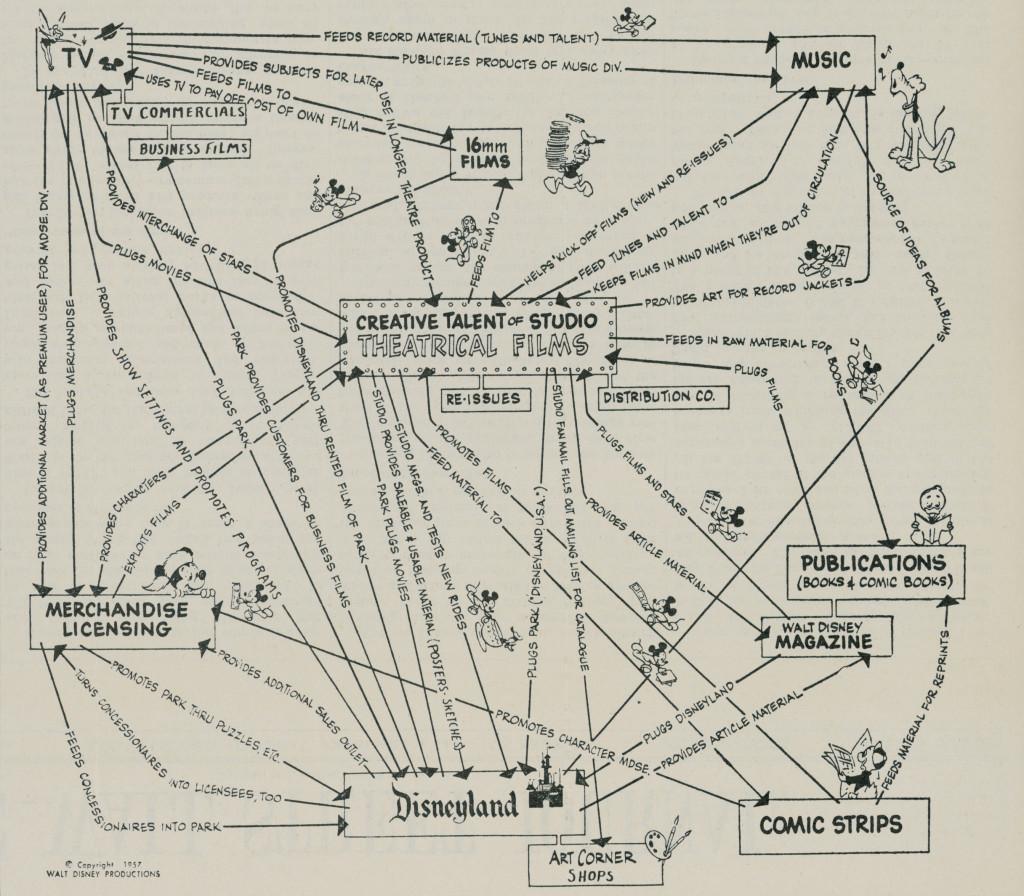
As an example of touchpoint strategy, Disney created this diagram in 1957 to visually decipher the brand output and identify how some outputs will feed back into others in a system:
Can Art Stop a War and Save the Planet?
• You go about your daily life and a poster will catch your eye and often uses bold colours to present a message.
• Posters don’t just promote stopping war, they can promote and even become a tool for recruiting i.e. to fight in the war
• Another mother for peace organisation have used ‘war is not healthy for children or other living things’ poster as their logo
• Posters are more intense than a magazine, newspaper or editorial where you can flick through the page. The impact is that the image stays with the audience for longer. From a political stance, “And Babies?” will not let people forget the tragedy of war
• Shepard Fairey – Obama’s campaign
An Introduction to Design for Social Innovation

1 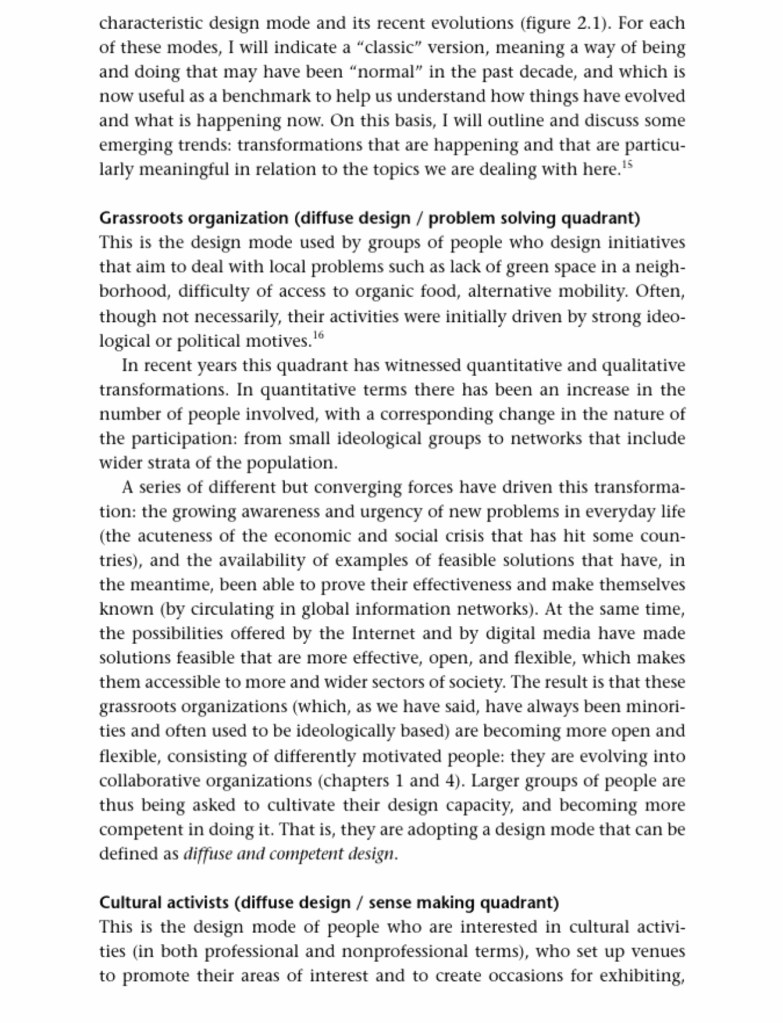
2 
3 
4 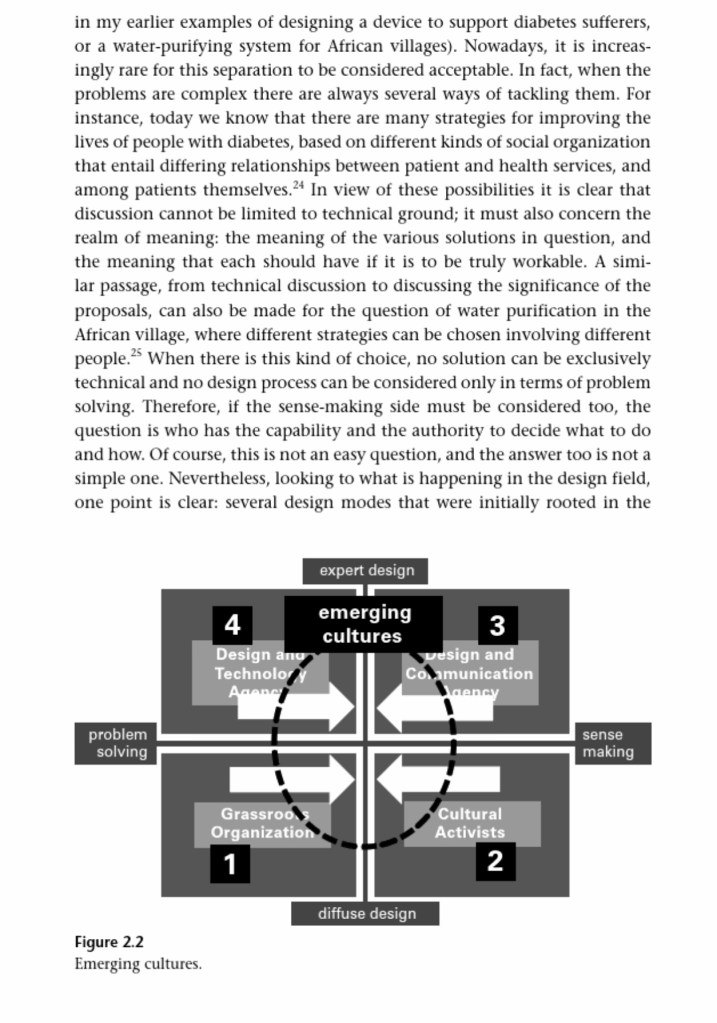
5 
6 
7
1: The design mode map helps to identify different people’s roles within a project and why they are doing it. It is able to differentiate between members of the team which is particularly useful as some people’s roles might be similar such as a ‘tech designer’ and ‘communication designer’; these are both valid and very different roles in that they could be at different stages of a project. Maybe a tech designer only comes into the project on final installation, and communication designer is based more at the beginning research stages.
2-3: Grassroots organisation is specifically targeting problems around social and economic problems, and now more than ever information is far easier to be researched with online networks. So much so that is becoming collaborative.
3: Cultural activists are people who are often young and living in an urban environment, and they use their city and home to send messages and create social groups. However, the introduction of social media is impacting cultural activism in that these platforms are being used as a tool to help connections and spread awareness around issues. We are experiencing a world where society is now becoming considerably opinionated and free speech is encouraged.
4: Design and communication agency are the experts solving problems relating to social and environmental issues, often collaborating with others. These experts are the key to bringing in the solution which combines innovation such as combining services, products and communication in one service outcome.
5: Design and technology agency are the experts with highly technical backgrounds that use technology to solve problems in design. Emerging design cultures is self explanatory in that it looks at upcoming trends and uses that to inspire the final outcome. Design and emerging qualities is problem solving and ensuring the outcome is relative to its form and function. If this doesn’t happen then the problem isn’t solved. Audience is an important consideration in design as it needs to consider not just the individual but communities also. There are similarities to this approach with grassroots organisations (above) as they are solving problems in a sustainable way.
6: Design as place maker is to create a local ecosystem where culture and production coexist in a balanced relationship with global design. This means meeting with stakeholders and organisations to develop local and regional projects. They can be countryside related, concern neighbourhoods and introduce mobility systems, but more importantly they consider the area and surrounding audience/location.
7: Design as activism encourages interest in areas of design but looking at them from a different perspective and thinking outside of the box. Fashion is a great example as communities can be associated with clothing trends (often stereotypical) and how certain things have associations. Examples are festivals, youth clubs, social centres etc. as these bring people together.
 jesswhatley.design.blog