
Workshop challenge
- Write the first draft of your 3,000 word article, to be saved as a Word or TextEdit document.
- Create an A3 landscape format inspiration board to present your initial ideas about the design approach, to include examples of materials, format, typography, print / digital production.
Research
First draft of essay
“MILTON KEYNES IS ONE OF THE BEST PLACES TO LOOK FOR MARINE FOSSILS”
Introduction
Milton Keynes is a new city built in the 1960’s, and many may feel as though it lacks history and personality. However, this essay will provide information regarding its history through evolution, including evidence of geology that appears today. In the Jurassic period, Milton Keynes was underwater as it was a shallow tropical sea, and therefore fossils such as brachiopods, oysters and molluscs are present in the layers of clay and chalk sediment today which is visible at several nearby locations, including the Chiltern hills. The aim of this essay is to learn all about how old the ground beneath our feet really is, how it came to be how it is today and raise awareness of the history here.
Overview of living in Milton Keynes
Milton Keynes is in the largest town in Buckinghamshire, England UK, and is fifty miles away from London. Initially built as an overflow for London’s housing in the 1960’s, Milton Keynes is now one of the most innovative, rapidly expanding cities in the UK. Famous for its Concrete Cows sculpture by artist Liz Leyh in the ’70’s, it has unfortunately become stereotypically known as a concrete city, full of roundabouts and industrialism as large corporations are housed for easy half way access across the UK (particularly convenient for deliveries). Whilst this is true, this does not in any shape or form impact the city in terms of its atmosphere, or environment. Milton Keynes is so much more than a city that hosts corporate buildings – most cities have these so why is Milton Keynes stereotyped singularly? Maybe it’s because of the assumption it’s another city just like London… My points below in this article will argue why you cannot compare these two cities.
Milton Keynes also hosts an impressive art gallery, museums and festivals that promote the cities creative spirit each year. I mentioned that the most famous piece of art is the Concrete Cows by Liz Leyh, however there is so much more. There are a selection of artist sculptures using various mediums, such as the Campbell Park Art which has eleven sculptures scattered throughout the grounds. One of the most famous pieces is titled Light Pyramid, an innovative light up sculpture that glows in the night. It’s conveniently placed on the higher levels of the grounds to be noticed from miles away in the dark, and when you visit it, hosts splendid views. When visiting the Linford Wood park trails (which I also mention further on in the article) you will find carvings inside the tree trunks, dating from 1987 to 2010 (Theparkstrust.com, 2020). There is a sculpture of a Triceratops, created by Bill Billings in 1979 which utilises concrete and chicken wire at Peartree Bridge. What is particularly great about this sculpture is that it gets repainted with the assistance of school children when it needs painting. There is a real sense of culture within the city and I think this is fundamental within a great network of people. A city that has community spirit will thrive.
Milton Keynes was designed on utopian principles, with the idea of being a modern interpretation of the ‘Garden City’ – a 1988 book by Ebenezer Howard in which the city would incorporate both town and countryside. Garden cities were specifically designed to be built in a grid formation to allow a proportionate amount of zones for housing, parks, industry and public spaces (Discovering Britain, 2018). The city has been built with the environment in mind; the innovative grid system (to help relieve traffic congestion) keeps roads separated from agricultural land and protected parks, such as the Parks Trust. There are lakes which support the cities environmental eco systems and food chains including popular birds of prey such as the Red Kite. I feel very lucky to live somewhere where there seems to be the right balance of everything required for great wellbeing, and to live an enjoyable lifestyle. Even though I live on the outskirts of the city, I am within minutes of a train station, food stores, restaurants and shops but more importantly, I have a lake on my doorstep, allotment a few streets away and countryside surrounding my area as houses have been built on the basis that they consider sustainable living. Some neighbourhoods also use Starship (Starship.xyz, 2019), small delivery robots to deliver groceries from the local grocery store to your door. I even have a solar panel on the roof of my house that runs electricity – if that doesn’t sum up the innovation within this city I don’t know what will!
Geological history of Buckinghamshire
One of the additional benefits of Milton Keynes being a relatively new city that people who don’t live here consider, is that there are so many exciting opportunities for archeological and geological discoveries as the ground hasn’t been excavated yet. A great example of this is a geologist named Michael Oates who joined a team of excavationists in 1987, in Aylesbury (twenty miles south of Milton Keynes), and upon investigation with his team of diggers realised that they had discovered eighty bones from a hundred and fifty two million year old Watermead Pliosaur – a top predator of the Jurassic seas (www.bucksas.org.uk, n.d). Doesn’t it seem so bizarre that the earth beneath us is rich with fossils and sediments and we’re only associated with what has been man-made on the surface? Another example is of a skeleton of a marine reptile named Ichthyosaur from the Jurassic period approximately 160 million years ago was discovered in 1982 by a workman during excavations for Caldecotte Lake, Milton Keynes. 75% of the fossil was preserved and conserved, and now exists on the wall of the city central’s library (Buckinghamshire Culture, 2020). This is really wonderful evidence that the city of Milton Keynes has a vivid history.
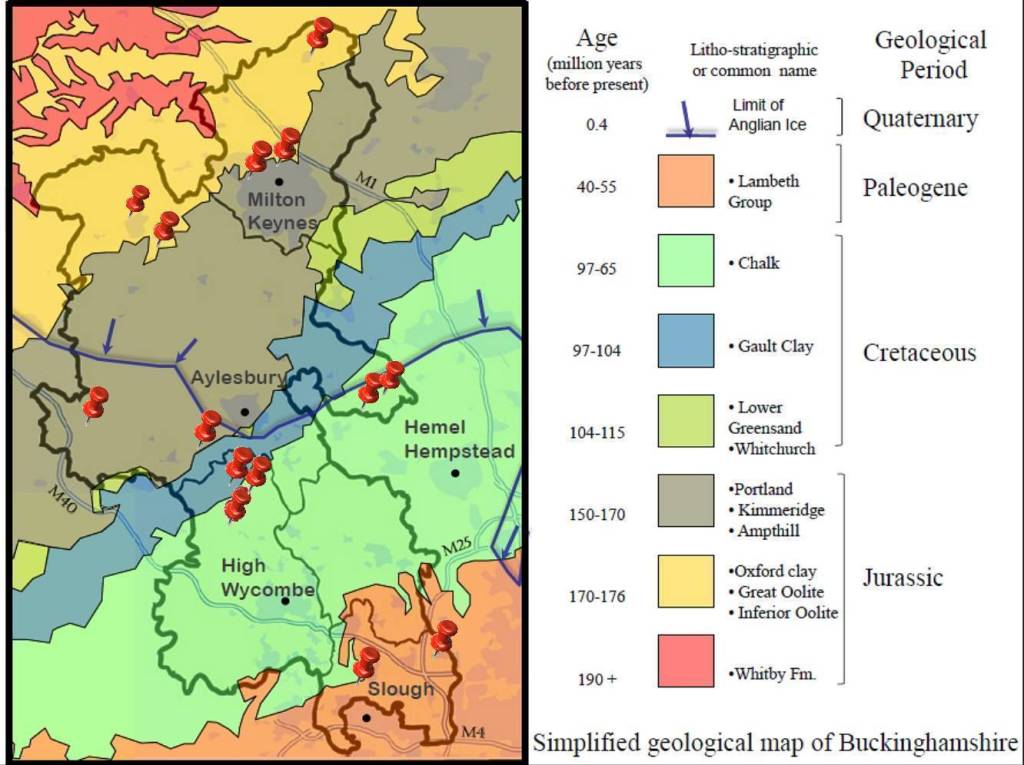
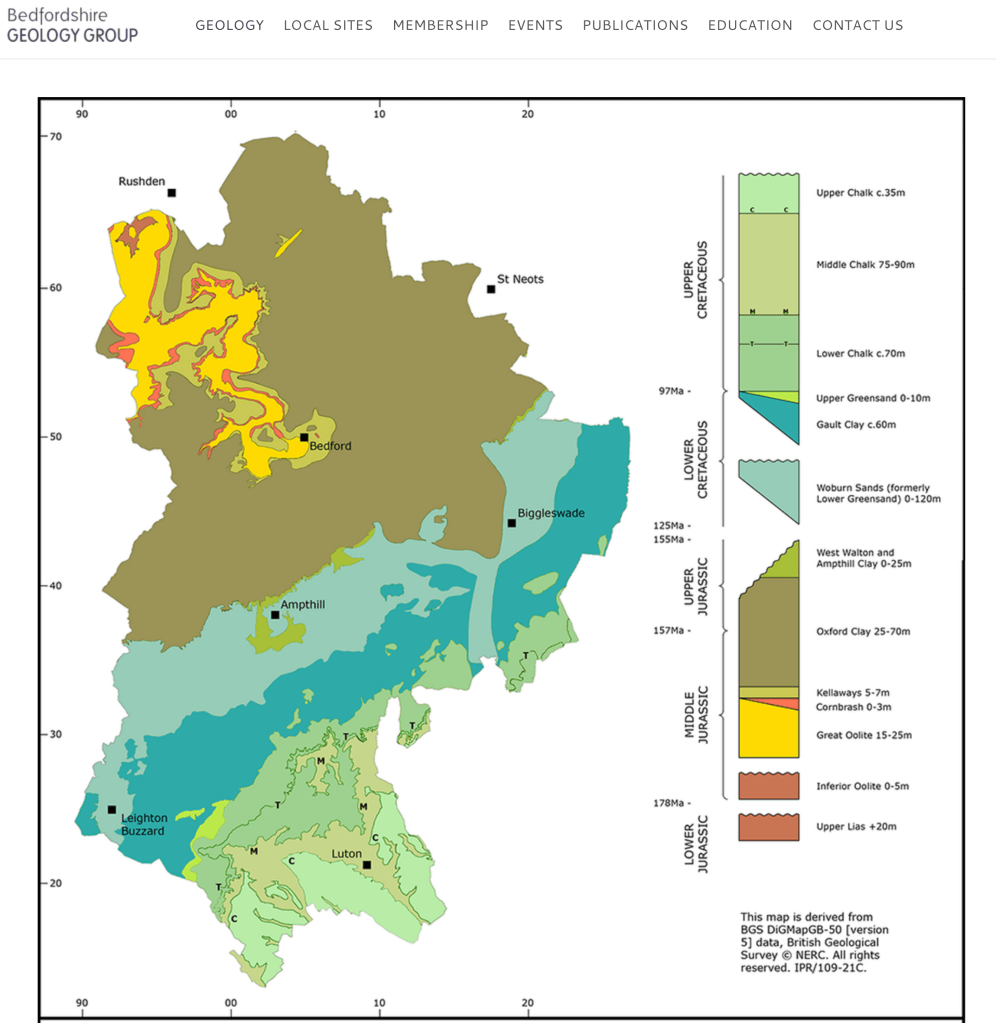
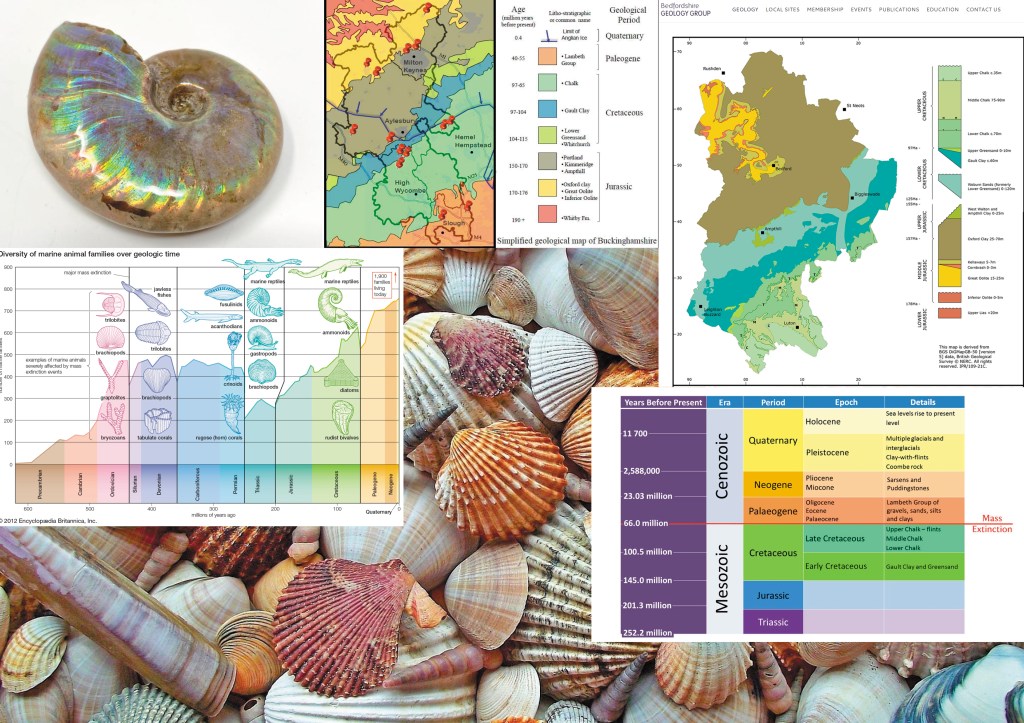
Milton Keynes rocks as a whole are up to two million years old, forming in layers of sand, clay and lime rich sediment which tells us they used to be underwater. They are sedimentary rocks which means they frequently contain fossils as deposits layer up over millions of years to compress and form the rocks. These layers are what gives the rock formations horizontal layering, and date back to 168.3 – 166.1 million years ago. (Bedfordshire Geology Group, n.d.) In order for a fossil to form, skeletal debris needs to decompose on the sea bed and over time will become preserved within the clay. Fast forward millions of years and you will see a fossil within a rock, perfectly preserved. These fossils are not just limited to sea creatures either, as there is evidence of plants and micro organisms that lived during ancient periods. The Greensand Ridge forms an area across the county of Buckinghamshire and formerly known as the Lower Greensand. During the early Cretaceous period, Milton Keynes would have been dry land for approximately 30 million years then flooded by sea due to global warming; with temperatures and sea levels rising. Examples of this Greensand can be seen in the walls of Husborne Crawley church. (Bedfordshire Geology Group, n.d.).
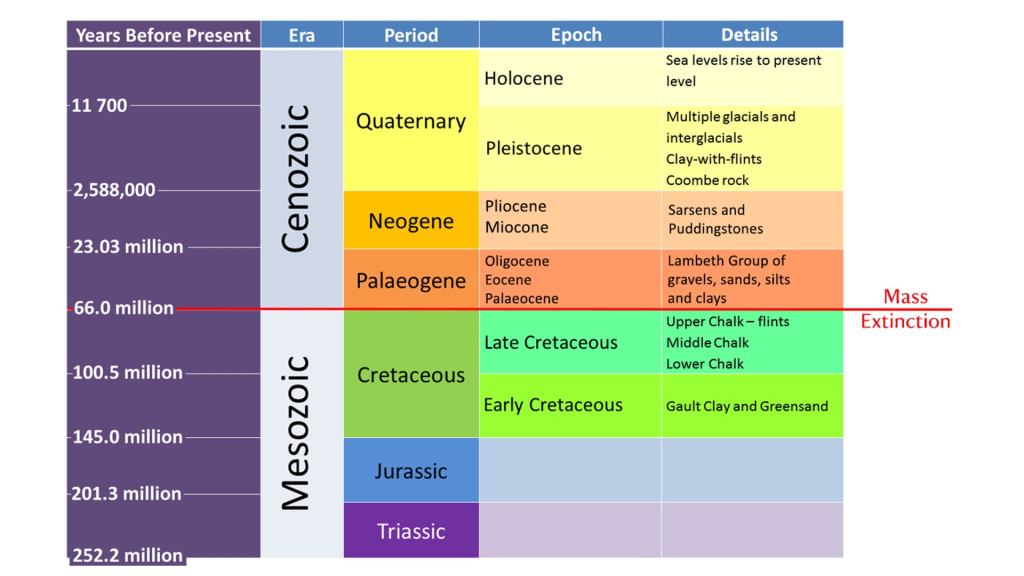
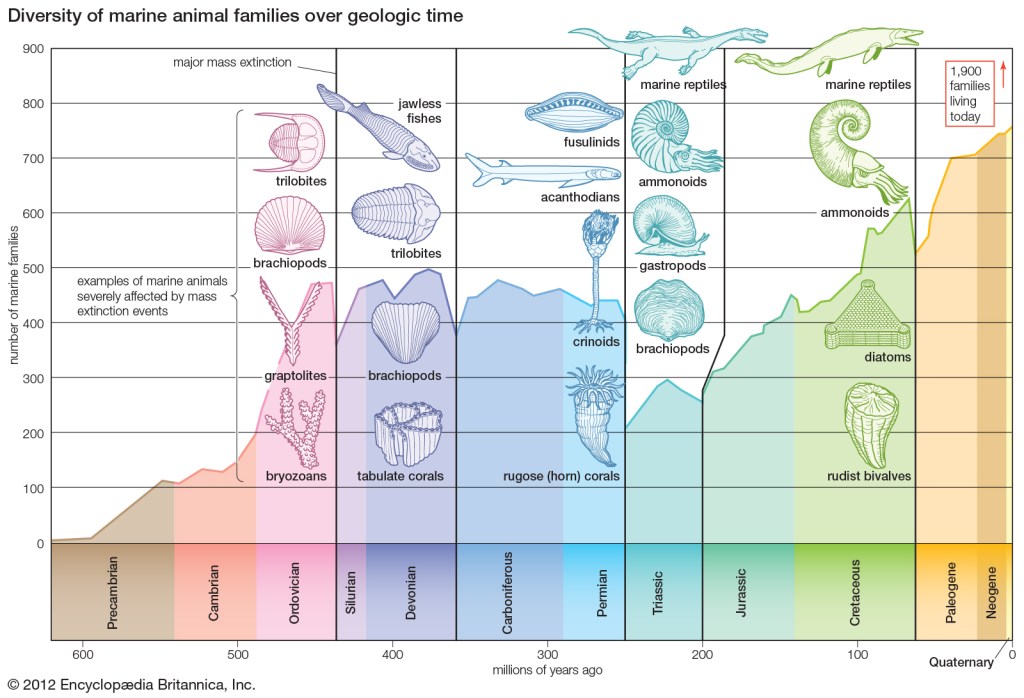
I now want to introduce you to the two main geological time periods (the most significant for fossils) identified within these layers of rocks which you will see in Buckinghamshire today. Fossils discovered have been traced back to their relevant time period as many are now extinct due to the K-pg extinction event – this was the mass extinction of three quarters of the plant and animal species on Earth approximately 66 million years ago (Wikipedia Contributors, 2019). The first is the Jurassic Period, which was approximately 199.6 to 145.5 million years ago and is split into three categories – lower, middle and late Jurassic. The late Jurassic period was a warm, humid climate that hosted lush vegetation and abundant life with many ocean creatures thriving during this time, particularly as the middle Jurassic period had a much cooler climate (Encyclopedia Britannica, n.d.). According to National Geographic (Science, 2017), the oceans were brimming with sea life as the climate temperatures gradually began to rise: ”At the top of the food chain were the long-necked and paddle-finned plesiosaurs, giant marine crocodiles, sharks, and rays. Fishlike ichthyosaurs, squid-like cephalopods, and coil-shelled ammonites were abundant. Coral reefs grew in the warm waters, and sponges, snails, and mollusks flourished”. It’s hard to imagine Milton Keynes being an underwater city, but that’s exactly what it was. The Jurassic period ended with a mass extinction of approximately 76% of marine and terrestrial species on Earth, caused by toxic sulphur volcanic eruptions (MIT News | Massachusetts Institute of Technology, n.d.) Then there was the Cretaceous Period – 145.5 to 65.5 million years ago is the period that ended and wiped out all dinosaurs to extinction as we know it, due to a 7.5 mile wide asteroid hitting the Earth at 45,000 miles an hour (Greshko, 2019). Interestingly, this devastation didn’t seem to impact sea creatures that we know existed in the Jurassic period and many creatures survived, however it did wipe out approximately 80% and one of the species were the ammonites (The Editors of Encyclopedia Britannica, 2019) which is how we know that they date back from this period of time.
So what fossils exist in Milton Keynes from this time? Bioclasts have been discovered within the limestone rock at Linford Wood, which are the tiny fragments of shells from Jurassic sea creatures. The weathering of these rocks is loosening the fossil shells from the sedimentary stone (www.youtube.com, n.d.). In Linford Wood there is a large presence of limestone also, which means there is evidence of this area being underwater in that time (Secklow Sound, n.d.).
The Chiltern Hills are 30 miles south from Milton Keynes, and built from clay-with-flints which are composed of micro-fossils, and sometimes its possible to find larger fossils such as ammonites, sea urchins, sea sponges, brachiopods, bivalves, sea snails and even sharks teeth (National Trust, n.d.). Within the Chiltern Hills are Dunstable Downs and Whipsnade Estate, which are well known by residents for its chalk lion carved into the countryside. At an impressive 483 feet long, the horse is visible from miles away. The carved chalk lion is effectively created to advertise the Whipsnade Zoo, however it’s a great reminder of the geology origins in the area too (www.hows.org.uk, n.d.). The artist who designed this was R.B. Brook-Greaves, and work began to create it in November 1931 and it has served as a timeless landmark ever since it was created – it still gets restored to ensure it remains in top condition. Speaking of chalk, it forms the central backbone of Buckinghamshire especially throughout the Chiltern Hills. It is actually a formation of soft, white limestone, which consists of microscopic fossils: “Chalk is almost exclusively formed from the minute remains of fossil algae, called Coccolithophores. The calcite skeletons of these minute organisms invariably disintegrated on death, and descended to the sea-floor, as a soft ooze.” (www.bucksgeology.org.uk, n.d.). Just like sand is broken down shells, rock and sea floor sediments, the clay within the Buckinghamshire countryside is a visible representation of millions of years of evolution.
So what about all of the sea creatures who lived in this county, I hear you ask? Most of these were crustaceans such as oysters and snails that we have today. However, ammonites were large coil shelled, sea creatures that lived on the sea bed, with similarities to the squid or octopus today. Their shells have preserved so well because they varied in size but generally were a rather large sea creature. They could grow up to three feet in size, and due to having a short life span there are thousands of these fossils globally as there were a high volume of ammonites that existed in the Jurassic and Cretaceous periods. They were not just local to Buckinghamshire, but its nonetheless still impressive to find a fossil that is so ancient. (British Geological Survey, n.d.). As a passionate mineral collector I own many of these wonderful ammonites – for display and for jewellery. They may not have been flashing with rainbow colours when they existed all those years ago, but ammonite shells are often iridescent due to the layers of fossilisation causing a shift of rainbow colours when tilting which is called chromatic shift and rotational range: “The iridescence is due to the organic microstructure of the aragonite, which causes light to rebound from stacked layers of thin platelets. This is different from any gemstones with iridescence. Iridescence is typically a result of light absorption, but ammonite colour is a result of light interference. Thicker layers produce reds and greens, while thinner layers result in blues and violets.” (www.treasuremountainmining.com, n.d.) Layers of rock also display mineral deposits such as calcite, selenite, chalcedony and marcasite. These minerals are evidence of evolution themselves as they only form under specific conditions, and timescales. For instance, calcite forms on limestone sediments so they would develop over a long period of time, but also are formed from the shells of marine organisms. Isn’t it incredible how sea creatures can live on for all of this time in other forms? This is something that I find so fascinating, particularly within geology. The more you look at your environment, the more there is to learn!
Summary
In conclusion, there is so much to learn about Milton Keynes and its history, that should be made known. That is not limited just to geology; there are impressive artworks and sculptures that present creativity throughout the city. The city is innovative, sustainable and designed for the future with a housing and ecological system that is fulfilling residents the needs of those who travel through it, live in it or visit it. It is a city filled with history and geology is fantastic evidence of this and yet this is not what it is recognised for; I know I will be actively spreading the word about these to raise awareness. I hope you have learned something new from my essay and next time someone tells you about the ‘concrete city’, correct them.
Bibliography
http://www.bucksas.org.uk. (n.d.). Buckinghamshire Archaeological Society – History of Bucks in 12 Objects – Pliosaur. [online] Available at: http://www.bucksas.org.uk/obj1pliosaur.html [Accessed 21 May 2021].
Bedfordshire Geology Group. (n.d.). Geology. [online] Available at: https://www.bedfordshiregeologygroup.org.uk/geology.html [Accessed 21 May 2021].
Science. (2017). Jurassic Period Information and Facts. [online] Available at: https://www.nationalgeographic.com/science/article/jurassic.
ucmp.berkeley.edu. (n.d.). The Cretaceous Period. [online] Available at: https://ucmp.berkeley.edu/mesozoic/cretaceous/cretaceous.php
Encyclopedia Britannica. (n.d.). Jurassic Period – Paleoclimate. [online] Available at: https://www.britannica.com/science/Jurassic-Period/Paleoclimate.
British Geological Survey. (n.d.). Ammonites. [online] Available at: https://www.bgs.ac.uk/discovering-geology/fossils-and-geological-time/ammonites/.
The Editors of Encyclopedia Britannica (2019). K–T extinction | Overview & Facts. In: Encyclopædia Britannica. [online] Available at: https://www.britannica.com/science/K-T-extinction.
Wikipedia Contributors (2019). Cretaceous–Paleogene extinction event. [online] Wikipedia. Available at: https://en.wikipedia.org/wiki/Cretaceous%E2%80%93Paleogene_extinction_event.
MIT News | Massachusetts Institute of Technology. (n.d.). Huge and widespread volcanic eruptions triggered the end-Triassic extinction. [online] Available at: https://news.mit.edu/2013/volcanic-eruptions-triggered-end-triassic-extinction-0321.
Greshko, M. (2019). Mass extinction facts and information from National Geographic. [online] Science. Available at: https://www.nationalgeographic.com/science/article/mass-extinction.
www.youtube.com. (n.d.). Geology at Great Linford Manor Park. [online] Available at: https://youtu.be/4gP9n75ycr0 [Accessed 21 May 2021].
Secklow Sound. (n.d.). Multi-million-year-old fossils remain at an ancient quarry in a Milton Keynes estate. [online] Available at: https://www.secklow1055.org/news/local-news/multi-million-year-old-fossils-remain-at-an-ancient-quarry-in-a-milton-keynes-estate/ [Accessed 21 May 2021].
National Trust. (n.d.). The Geology beneath the Chilterns Countryside. [online] Available at: https://www.nationaltrust.org.uk/chilterns-countryside/features/the-geology-beneath-the-chilterns-countryside [Accessed 21 May 2021].
http://www.treasuremountainmining.com. (n.d.). Ammolite: The Fossil with the World’s Most Spectacular Iridescent Colors. [online] Available at: https://www.treasuremountainmining.com/index.php?route=pavblog/blog&id=116#:~:text=WHAT%20CAUSES%20THE%20COLORS%20IN [Accessed 21 May 2021].
Discovering Britain. (n.d.). Soulless suburb or urban utopia? [online] Available at: https://www.discoveringbritain.org/content/discoveringbritain/trail%20booklets/Milton%20Keynes%20trail%20-%20written%20guide%202018.pdf [Accessed 2018].
Starship.xyz. (2019). Starship. [online] Available at: https://www.starship.xyz/.
Buckinghamshire Culture. (2020). Caldecotte Ichthyosaur. [online] Available at: https://buckinghamshireculture.wordpress.com/bucks-in-100-objects/caldecotte-ichthyosaur/ [Accessed 21 May 2021].
Theparkstrust.com. (2020). Linford Wood Carved Sculptures. [online] Available at: https://www.theparkstrust.com/our-work/public-art-in-our-parks/linford-wood-carved-sculptures/ [Accessed 21 May 2021].
http://www.youtube.com. (n.d.). Iconic chalk lion restored at ZSL Whipsnade Zoo. [online] Available at: https://youtu.be/l4HOZRnsa6I [Accessed 21 May 2021].
http://www.hows.org.uk. (n.d.). Whipsnade White Lion. [online] Available at: http://www.hows.org.uk/personal/hillfigs/whips/whips.htm [Accessed 21 May 2021].
http://www.bucksgeology.org.uk. (n.d.). BGG Chalk Page. [online] Available at: http://www.bucksgeology.org.uk/chalk.html [Accessed 21 May 2021].
This is 2925 words including headers, and bibliography.
 jesswhatley.design.blog