
Reference material
So You Want to Publish a Magazine
01. So You Want to Publish a Magazine?
• If you’re a printed magazine, having an online presence is essential. At the very least, it’s a quick reference point for readers, and it could also be an important partner to the magazine in terms of content. The web can perform tricks that are alien to print, such as allowing you to publish news in a matter of minutes, host film and animation, and make intelligent connections using the power of the click.
• But this is also an extremely competitive world. If you’re trying to attract readers in bookshops and newsagents, yours will be one of many new titles every month, up against established favourites. Sasha Simic of the independent UK distributor Central Books reports that he is approached every week by three or four new magazines seeking distribution. This competition ensures high standards of design and editorial, since magazines rise and fall on the merits of their offering to the reader, and quality is essential to that. ‘The idea that print is dead comes up again and again,’ says Matt Willey, creative director of Port and the New York Times Magazine . ‘Print isn’t dead. And right now is a really, really interesting moment. But you have to justify your presence in print, which is a good thing.’
• You may care passionately about your subject, but you must make something that other people will regard with equal fervour. And that’s just the tip of the iceberg. Once you’ve established that there is an audience for your magazine, you must let enough people know about it, inspire them to buy it, and keep delivering content and design that make them crave the next instalment. ‘Niche’ needn’t mean ‘irrelevant’, especially if your idea genuinely taps an uncared-for market.
02. Choose Your Own Adventure
• For a lot of indie publishers, their magazine can’t pay them a full-time living wage; it’s a passion project carried out at evenings and weekends, or something they can piggy-back on to their other work as writers, designers or photographers. Indeed, it may well be a showcase for their talents and a driver for new business. For these publishers, the motivation is not directly about making money, it’s about the three Cs: creativity, collaboration and communication. Having the opportunity to put something brilliant together, work on it with amazingly talented people and get it out to an audience is all the payment they need.
• The way you structure the logistical and financial side of your magazine is just as important as how it will look and read. Sketching out the numbers is the first step in a lot of big decisions, and is bound up with choices about how you’ll produce the physical object. It is sensible to start with a clear plan, even if it is modest in scale; you can always adapt and develop it later. As you determine the basics, such as print run, frequency and revenue streams, each piece of the jigsaw will help you to place the next. If you’re starting small, with your own money, take baby steps. If you mean to launch with an ambitious statement of a magazine, be prepared to plan in excruciating detail and get investment. At one end of the spectrum, you might be printing 500 copies of a 32-page A4 (or 8½ x 11 inch) stapled magazine to send to blog readers or members of your club twice a year. At the other end is a monthly magazine printing 100,000 copies, to be sold in bookshops and newsagents around the world, carrying advertising from high-end global brands. Most indie magazines sit somewhere between these poles. ‘I don’t think there’s any shame in starting by making 1,000 copies of something – you don’t have to do the finished product straight up,’ says Will Hudson of It’s Nice That . ‘Do a newspaper to show an editorial tone, get it out and into people’s hands, then see if it leads to something.’
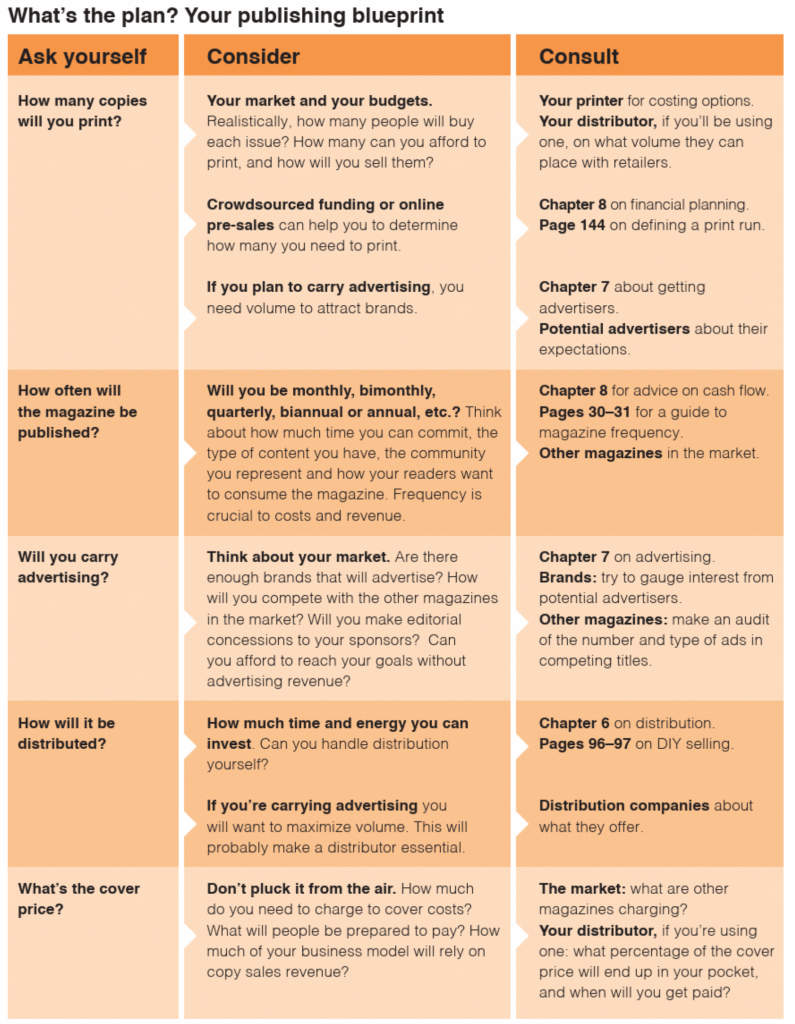
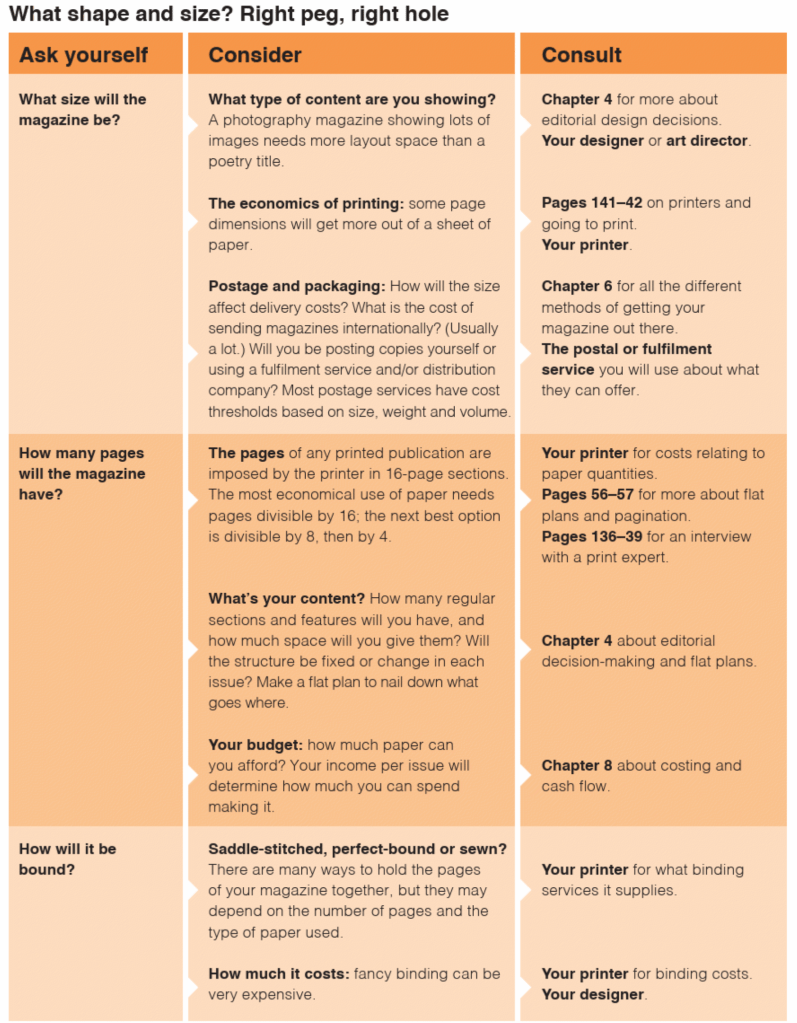
• If you’re making a printed magazine, you need to define its shape and size. Consider not only the aesthetic implications of the dimensions and thickness of your magazine, but also what they will mean for your costs. Speak to your printer about the most economical dimensions and extent (number of pages). Think about how the object will best work as a vehicle for the content. Your method of distribution might affect the size and shape. Ask yourself whether it is more important that your magazine is economical to post, or that it stands out on retailers’ shelves, and consider that you may have to live with these early decisions for a long time.
• Thinking about the audience and how often you want them to purchase your magazine: “It’s definitely a bigger percentage who buy it from the newsstand, I think because it’s a biannual. There’s a bigger need to have a subscription with a monthly magazine, because you feel you miss out on something, whereas with a biannual it’s more desirable to go [to a shop] and buy it. We have institutions who subscribe – museums and schools and so on – and companies. We have seen an increase in that type of subscriber.”
03. Ink and Pixels
• Assembling the right team around you is one of the most important things you can do to sustain yourself as a magazine. It could be that you have a natural team of collaborators from the start, or you might have to seek out the right people to help you get your title out, make it look great and sell it. Whatever your size or set-up, a magazine team needs to be tight, because there will be late nights and difficult decisions. The key people making a magazine need to be on the same wavelength, with shared reference points and attitudes to work. Several of the editors at the top of the independent magazine field say the same about what makes a good team: work with your own peer group, they say, and don’t just seek people with an established name because you like what they’ve done before. It’s about giving voice to your gang, writing about what you know and not just saying what you think people want to hear. ‘The magazines I think are great are made by people who make them for themselves and their friends,’ says Penny Martin, editor-in-chief of The Gentlewoman . ‘That’s not to say they’re exclusive. They’re just confident and specific in tone.’ Work with people you respect and can develop with: ‘A good magazine is not one person’s point of view,’ says Jefferson Hack. ‘A real, genuine magazine has to have a series of strong leaders and strong points of view. A really good editor-in-chief, a really good graphic designer, a really great photo editor: the three of them need to be at a similar level. If one is weak it lets the whole thing down; you’re looking at it going, “Nice photography, shame about the words.” All those elements need to be in synch.’
• Expect your team to work hard, nights, and to be full time. The majority of magazine publishing/editorial staff are not part time.
The layout book
• Consider where the viewer will look – A (left) then B (right across the page) and C (lower central page).
• Set the pace using full pages, half pages, image and text.
• Using the grid to arrange content on a page, and also how content looks on a screen as this varies considerably from print.
• Baseline grid to generate the correct size type regardless of typeface and weighting.
• Frutiger’s Grid – to identify the width and height of letters.

 jesswhatley.design.blog