
Challenge
Some initial ideas for this week:
A news story
– I could pick something relating to the environment
– The icebergs melting article I looked at in week 4 last week has stuck in my mind
A children’s story
– Alice in Wonderland – Lewis Carroll
– The Snail and the Whale – Julia Donaldson
– The Nightmare Before Christmas – Tim Burton
– Jabberwocky – Lewis Carroll
– Winnie the Pooh – A A Milne
– Old Bear Stories – Jane Hissey
– Dr Seuss – Oh the places you’ll go!
A launch document for a new brand
– Food
– Fashion
– Beauty
– Mindfulness
A love letter
– A letter to all things I am grateful for
– A letter to my passion as a creative
A business plan
– An independent illustrator
– A typographer
– A photographer
A diary
– Food diary
– Nature diary (such as wildlife in garden)
– Exercise diary (daily walks)
– Diary of my time spent each day
A manifesto
– Of my career plan
– Of my achievements
– Of my 2021 goals
A speech
– David Attenborough
Chosen piece: Dr Seuss – Oh the places you’ll go!
The tone of my chosen piece:
• Short, sharp sentences that build up the reader to great heights, but at the same time bring them back down to Earth
• Motivational, encouraging, passionate; then presenting the reader with the imperfect reality that things rarely go as expected
• Playful, childlike in tone as addressed to children. Poetry has been used; rhyming
I have decided to write my response as “option 1”:
– Pick one of the ‘tone of voice’ examples outlined in the workshop challenge (children’s book, manifesto etc)
– Write 400 words to analyse the effectiveness of your chosen ‘tone of voice’ example.
– Sketch (create a rough design) to visualise your 400 words.
To begin with I went back to basics as I did with my English studies years ago, and printed an extract (400 words to match the brief!) in order for me to analyse some techniques that Dr. Seuss used in this poem:
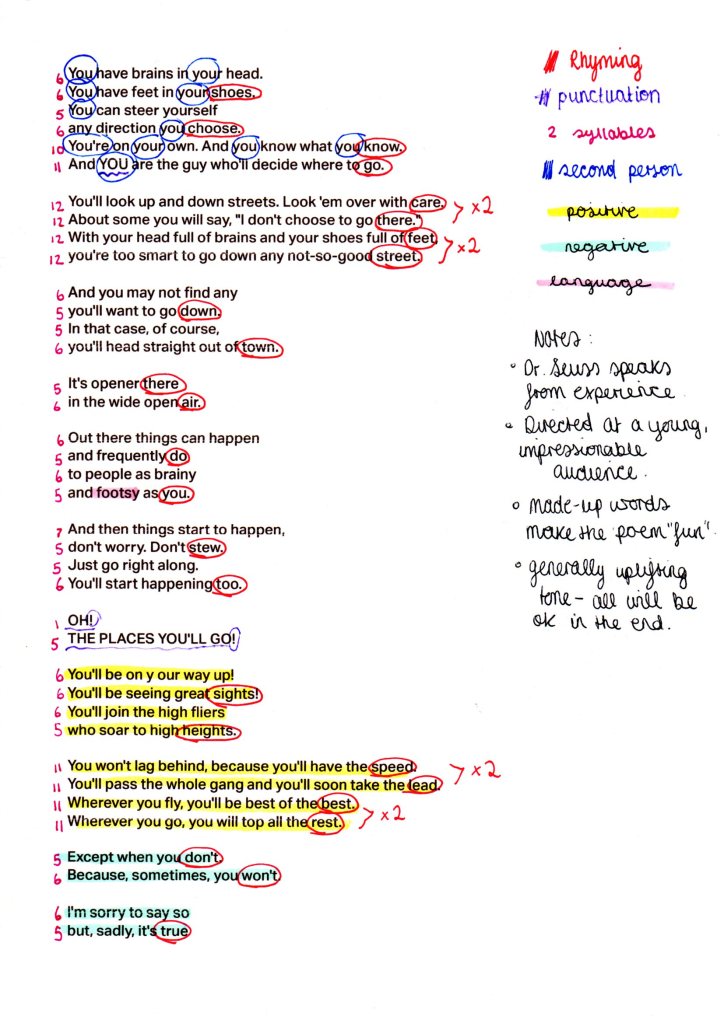
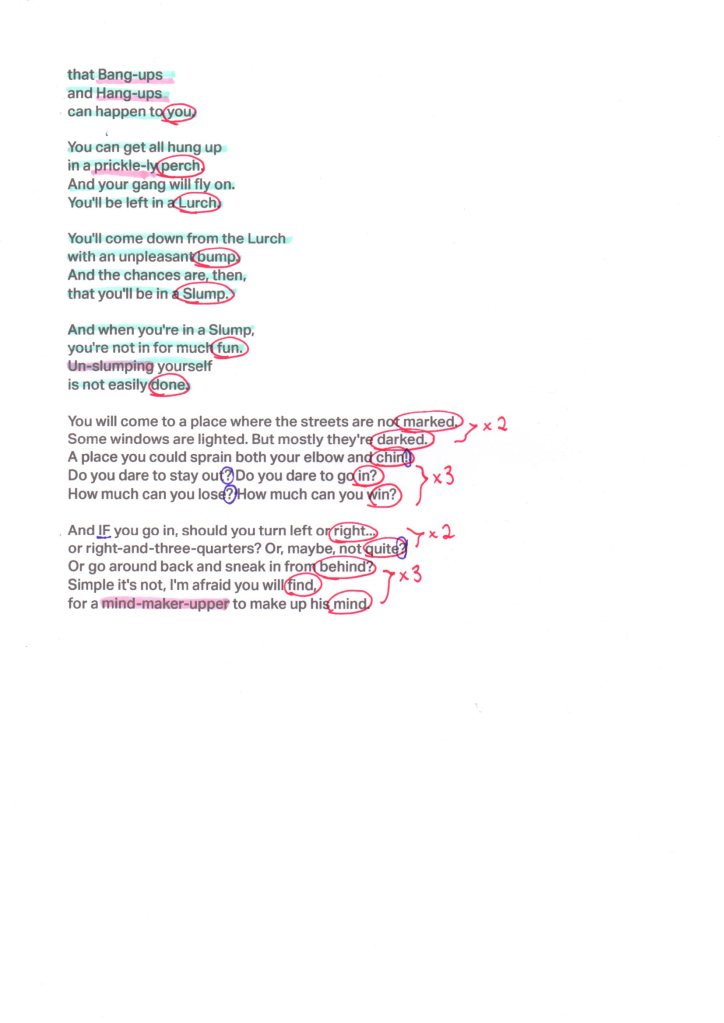
400 words tone of voice – beginning to analyse literature:
Language
Dr Seuss writes in anapaestic tetrameter, which is consisting of 5-12 syllables in each sentence allowing the second person narrative to be broken into paused speech. The structure of this automatically gives the poetry a narrative when read; and readers are likely to hear the poem with different voices. The most dominant voice being the author himself who advises from his own experience to date of the world. Alongside this technique, rhyming is prevalent throughout his work and clever use of punctuation keeps the readers engaged on an emotional rollercoaster. Capital letters and exclamation marks startle the reader; whilst question marks encourage creative thoughts and questions about self-worth. The playful language that Seuss uses in his work is relevant to his reader; targeting a younger audience with words such as ‘footsy’, ‘prickle-ly’ and ‘mind-maker-upper’ that hold similarities to small children’s vocabulary.
Audience
This poem is aimed at children, or those who are young and graduating from school, college or university. The audience is ideally unexperienced as to what the world will bring in their futures, as this poem demonstrates the unexpected highs and lows of life in general. What I particularly enjoy is how the poem is structured into motivating the reader but then suddenly switches tone into the reality of how life isn’t always idealistic, and ‘un-slumping yourself is not easily done’. Seuss reminds the reader that although life is difficult, it’s possible to not let it get to you and almost offers support like that of a parental figure. I think young audiences could look up to Dr. Seuss’ work as influential and logical, writing that seems like the fundamental next steps following graduation.
• Think about Dr. Seuss from a graphic design point of view i.e. as a brand. The name, and why it’s effective? This article from Heinz marketing describes how the name behind the brand developed.
• Consider the four tone of voice elements from snowball digital; humour for instance which is predominantly used throughout his poetry and how?
• Interesting insight into all the made-up vocabulary in all of Dr. Seuss work from sparknotes – such as Zizzer-Zazzer-Zuzz
Images of the book I own:
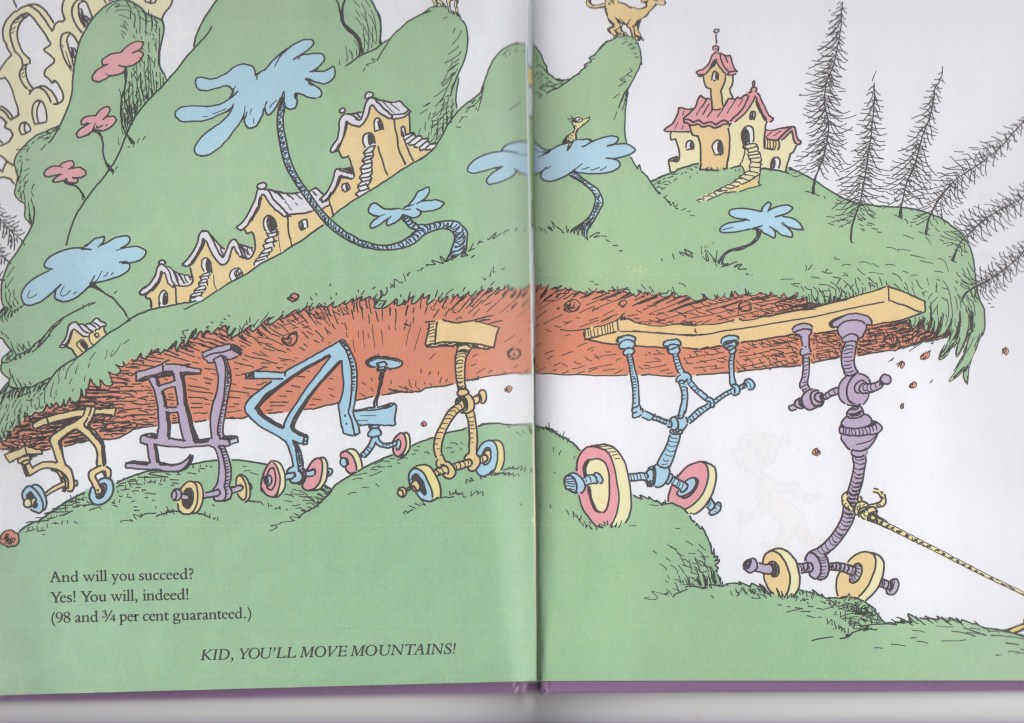
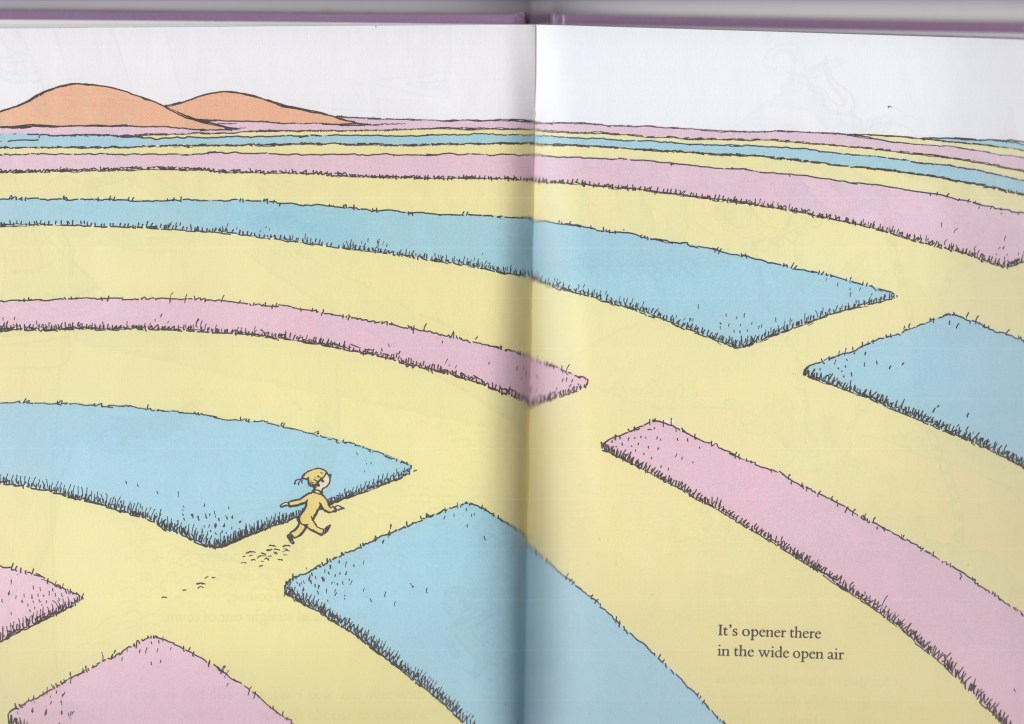
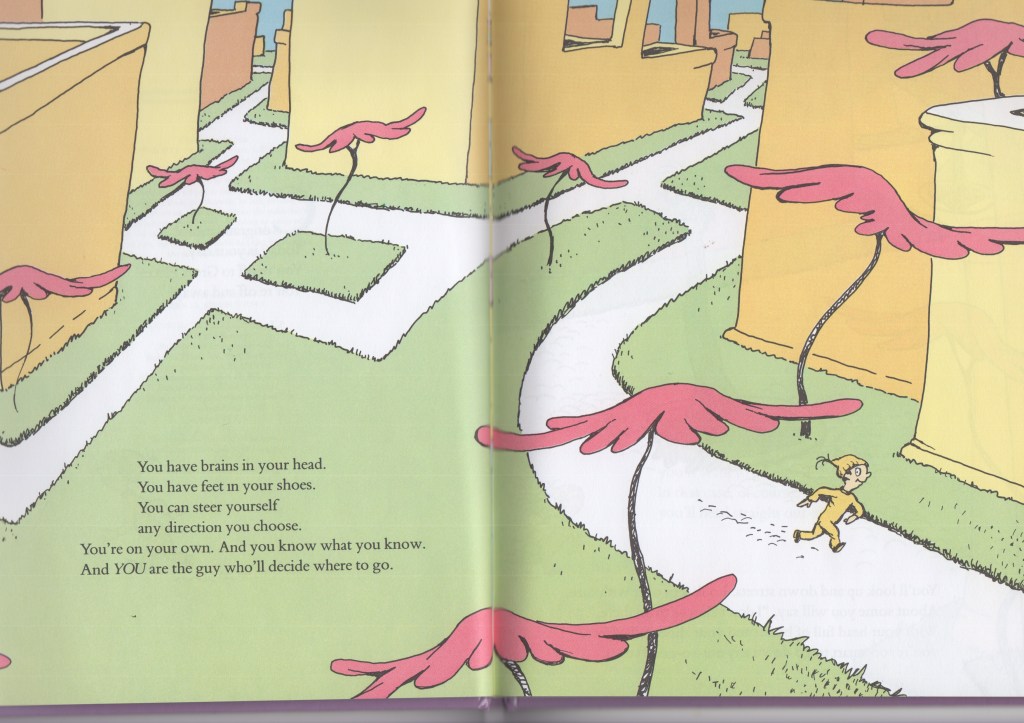
• Looking into the branding I have discovered how the pyjama wearing people illustrations were created. Ted briefly stated to a friend that he wanted to walk outside in pyjamas and it stuck, making an appearance in today’s books. Also, the main rainbow illustrations for Oh The Places You’ll Go! were taken from inspiration of a dartboard. The comparison of a dartboard to Dr. Seuss book apparently ‘alludes to the pursuit of excellence in life despite the challenges one may face’; which is a very valuable insight to the reasoning behind the illustrations for the book and more importantly does actually seem like the audience could be all ages (info from drseussart)
 jesswhatley.design.blog