
NFTS: Non Fungible Tokens
Following on from peer feedback I said in week 3 I wanted to further research NFTS. I am hoping to understand more about them and what the impact in the design world of these is.
I have already watched the introduction video about NFTS in week 3, and now I want to understand how they work in the design world/creative industries.
CryptoKitties
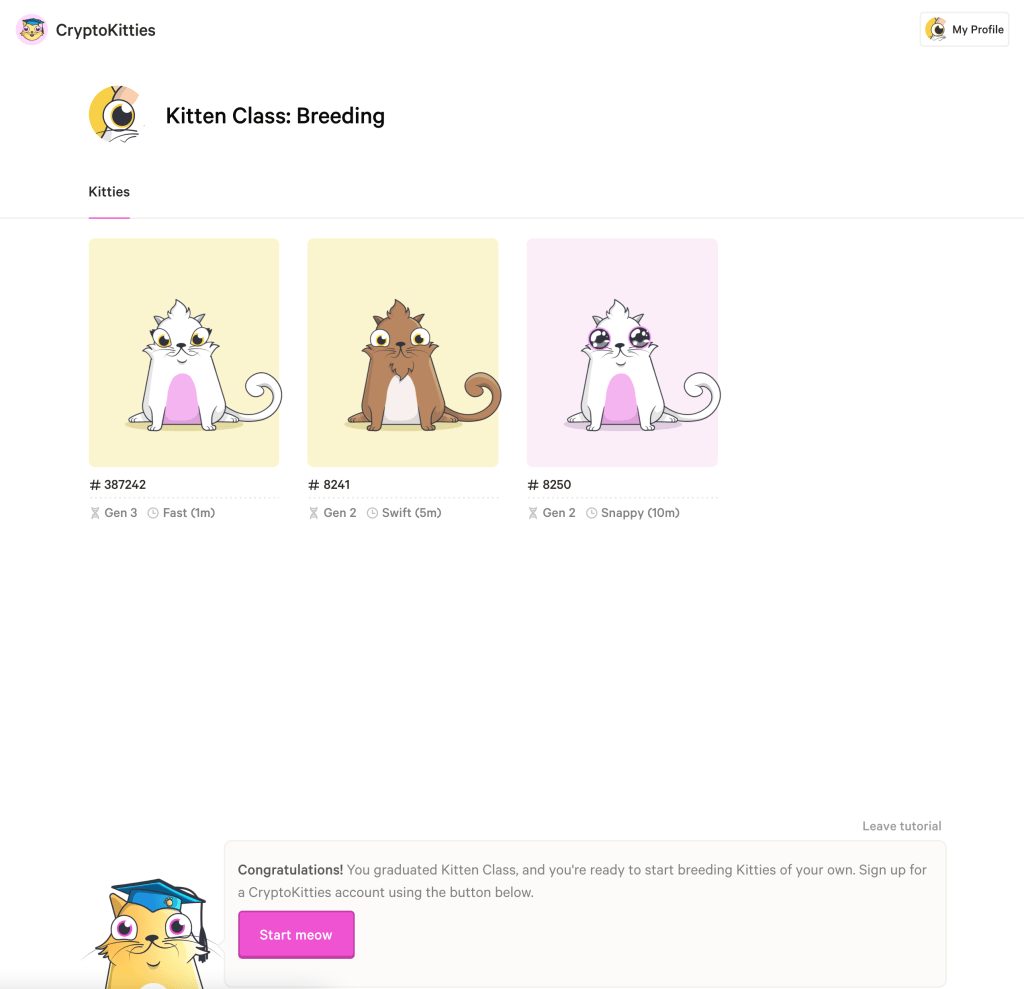
I experimented with visiting the site and playing with creating a kitty. It all sounds really complex but is based around a cute animated game, and works by breeding little cats and trying to create a rare kitty which can sell for a lot of money. I read up on how certain breeds are worth more, including how when creators accidentally create ‘misprint’ kitties with artwork mistakes.
However, now that I’ve understood this angle I need to bring it back to questioning: is it sustainable practice? Before researching the reasons why, logically it makes no sense for it to be good for the environment as each piece of artwork will be generating a lot of energy and space within data storage (i.e. blockchains). I am questioning how this could be a good thing at the moment before researching for those reasons… I want to see if they are actually sustainable?
“In order to “mint” a piece of art on the blockchain and become the official owner, an exorbitant amount of computing power and energy is used to solve complex puzzles in a process known as mining. Ethereum, the open-source blockchain that hosts NFTs, uses a purposely inefficient “proof of work” (PoW) method to create these digital assets.
Powerful computers can make an unfathomable number of attempts every second to produce new blocks. Whichever miner gets to the answer first gets their unique asset added to the blockchain. The “puzzles” get more difficult to solve as the price of cryptocurrency inflates and more computers are trying to solve them. It creates a perpetuating cycle of greater computer power and larger warehouses and stronger cooling units just to keep up — and an exponentially rising carbon footprint.
This amount of work is intentional — it creates a competitive market and prevents security threats. But the emissions generated in the process are also contributing to the destruction of Earth’s atmosphere.”
Source above explains how protecting artwork digitally is an incredibly complex process which consumes a lot of time, energy and storage. It is really bad for the environment; the mission to protect artwork in the modern, digital world where everything is easily copied/distributed, has resulted in harming our planet.
GITHUB
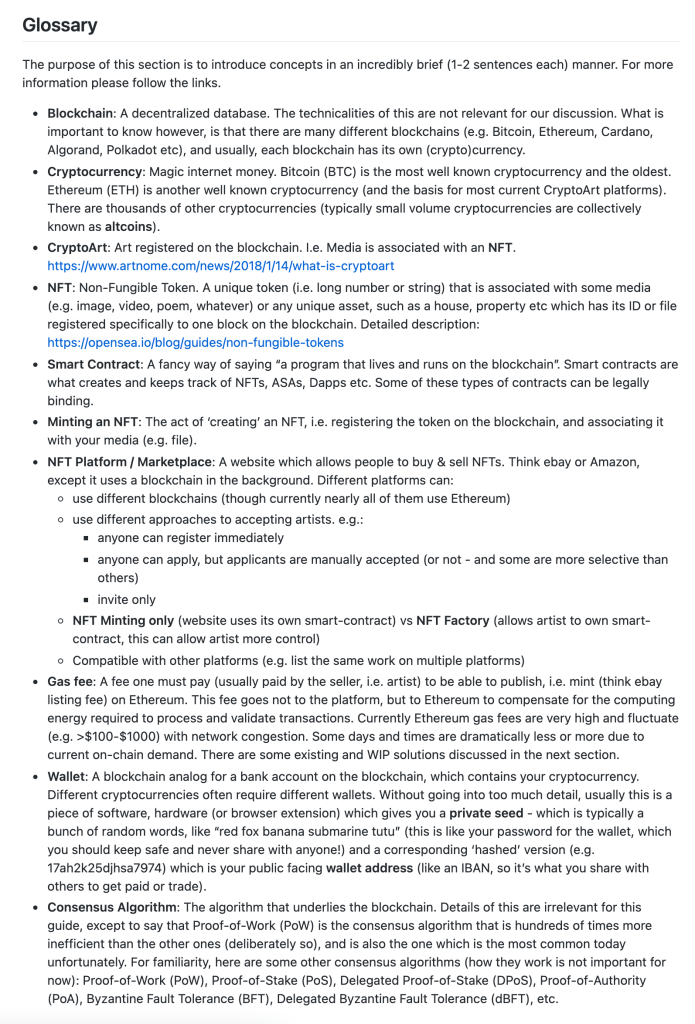
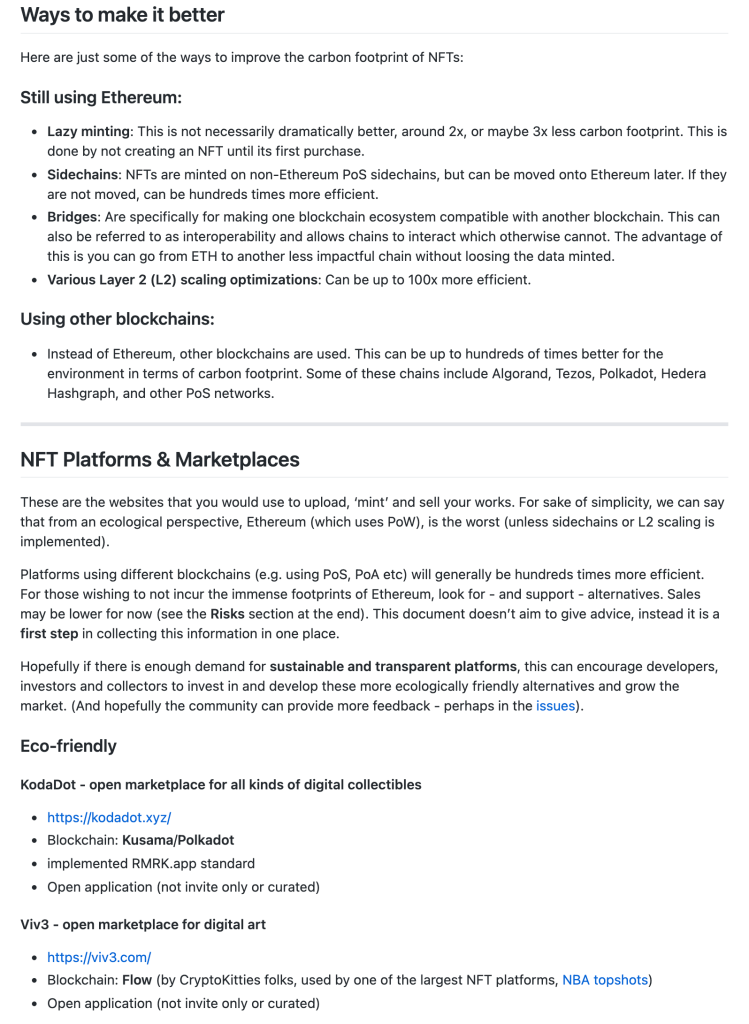
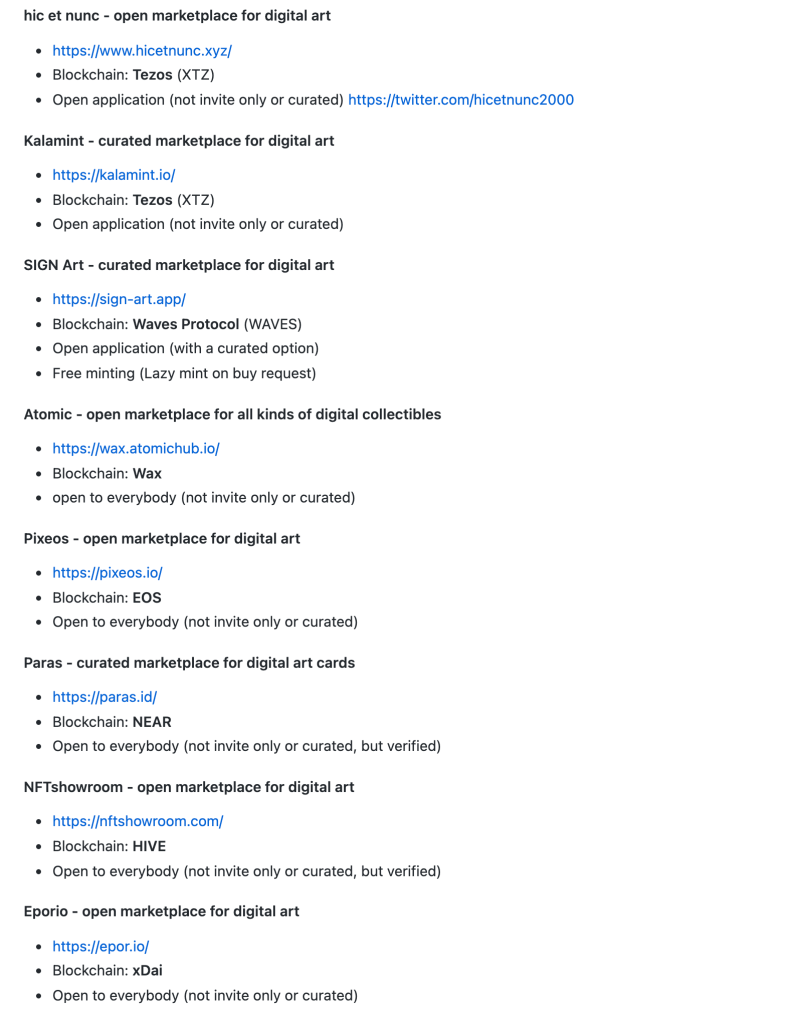
This website’s article ‘A guide to ecofriendly CryptoArt’ has provided a brilliant overview of all of the terminology associated with NFTS and their databases, including some information about NFTS can be more environmentally friendly:
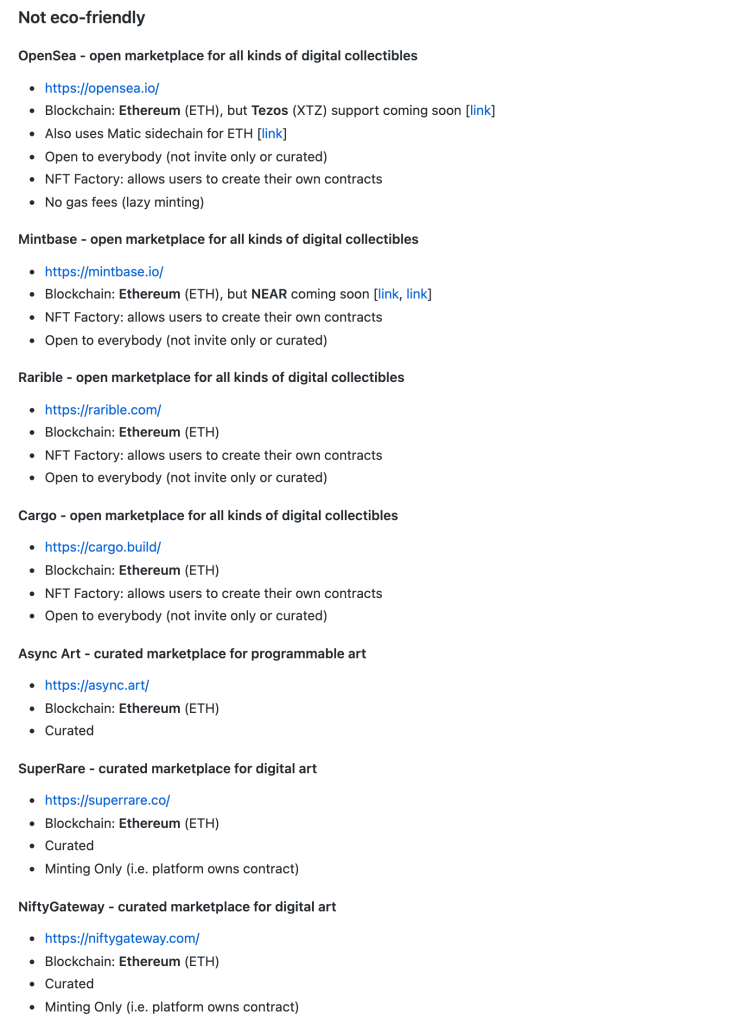
The Verge
“Take “Space Cat,” an NFT that’s basically a GIF of a cat in a rocket heading to the Moon. Space Cat’s carbon footprint is equivalent to an EU resident’s electricity usage for two months, according to the website cryptoart.wtf. That website used to let people click through the estimated greenhouse gas emissions associated with individual NFTs until creator Memo Akten took it down on March 12th. Akten, a digital artist, had analyzed 18,000 NFTs and found that the average NFT has a carbon footprint somewhat lower than Space Cat’s but still equivalent to more than a month’s worth of electricity for a person living in the EU. … He took the site offline after he discovered that it “has been used as a tool for abuse and harassment,” according to a note posted on the site.”
Wow! This is serious stuff and really quite shocking. The fact this site (cryptoart.WTF) had to be taken down is really interesting as it is clear that many people (not just artists) do not support NFTS and the harmful emissions generated. I’m interested to hear what people who have sold work via NFTS have to say about the sustainable side of it all…
“Digital artist Mike Winkelmann, who goes by the name Beeple, is a believer in a more sustainable future for NFTs. His work “Everydays: The First 5000 Days” was the one that got the eye-popping $69 million bid at Christie’s. Moving forward, he says his artwork will be carbon “neutral” or “negative,” meaning he’ll be able to completely offset emissions from his NFTs by investing in renewable energy, conservation projects, or technology that sucks CO2 out of the atmosphere. “I think you’re gonna see a lot of other artists do the same,” Beeple tells The Verge. But for now, there are still greenhouse gas emissions associated with his NFTs. It costs about $5,000 to offset the emissions from one of his collections, he says.”
I know about Mike Winkelmann from the ‘What is an NFT?” YouTube video above, and The Verge have managed to secure a statement with him about sustainable practice in the digital NFT world. I am really shocked that Winkelmann is fully aware his art would cost $5000 to offset the emissions from one collection yet still sells via that method??? Basically it appears if you are an artist that makes millions of dollars/pounds/euros etc. profit then you can afford to be environmentally irresponsible??? The fact Winkelmann also mentions about ‘investing in renewable energy’ after he has already created a lot of emissions makes no sense. If he cared that much would he have dealt with NFTS in the first place?
 jesswhatley.design.blog