
Presentation feedback in further depth
Data and its impact on the planet
“All of the shows and movies you stream, your important documents that you need access to everywhere, all of the information that you’ve uploaded to social media sties — it may take up little or no space on your devices, but all of that data has to go somewhere. That somewhere is typically data centers, massive buildings occupied by nothing but row after row of computer servers that are running nonstop to make sure that when you need to retrieve a photo stored in the cloud, you’ll be able to get to it right away. Data centers are the rarely discussed heroes that help make possible the incredible modern conveniences that technology has afforded us. But they have a cost.” Source
This video explains how data is left through all internet required movements online, which is actually quite scary! Even more so because we can’t physically ‘see’ the footprint and it’s all travelling through wires and electricity. It also provides tips on how to minimise data footprint which is useful.
“Why are data centres so environmentally unfriendly?
“For a data centre to remain functional, it either needs to have been built in a country with a naturally cold climate or to be housed in a temperature-controlled environment that must be maintained round the clock. According to studies, around 40 percent of the total energy that data centres consume goes to cooling IT equipment.” Source
Migrating 8 million data centres to Siberia is an unrealistic goal, but industry experts believe building data centres in cold countries could help cut emissions. Google tested this theory by opening a data centre in Hamina, Finland in 2009, and in May this year, announced it would invest a further €600 million in this eco-friendlier endeavour”
MIT Technology Review’s article explains the situation in Iceland with the data centres being located there and bringing in further revenue to small residential areas: “In a community this small, where residents have been historically dependent on agriculture and fisheries, the positive impact of such investment is “almost indescribable,” says Valdimar O. Hermannsson, Blonduos’s mayor. The influx of money means jobs are being created and homes are being built. There are even plans for a larger campus, many times the size of the existing facility. But to make that happen, the town will require the same things as Iceland’s data center industry at large—more demand, more customers, and more energy.” This seems to suggest that with data centre expansion comes a better living for those surrounding them in terms of financial wealth and lifestyle.
However, in terms of the environment –
“Google has been carbon neutral each year since 2007, which means that it offsets the emissions it generates from burning fossil fuels by investing in renewable energy projects or other initiatives that draw carbon dioxide out of the atmosphere and into storage. But relying on offsets doesn’t actually wean the company off fossil fuels. Google released 4.9 million metric tons of greenhouse gases in 2018 alone, roughly the amount that more than 1 million passenger vehicles might put out in a year.” Source
“Google is also considering turning to nuclear energy, which isn’t considered renewable since it involves mining uranium and creates radioactive waste. But advanced nuclear energy is supported by some environmentalists because it doesn’t create carbon dioxide emissions. “We believe that all carbon-free technologies have a role to play in zero-carbon electricity systems and that, given the urgent challenge of decarbonizing electricity systems as quickly as possible, no such technology should be taken off the table,” a spokesperson for Google said in an email to The Verge.
Google’s new commitment meets one of the demands made by more than 2,000 of its workers last year, who called for zero carbon emissions by 2030 and joined a global climate strike with other tech workers in September. Workers at Amazon and Microsoft have made similar demands asking their employers to stop releasing greenhouse gases by 2030, but Google so far is the only tech giant to commit to do so. None of the companies have met employees’ additional demands to end contracts with fossil fuel companies and stop funding politicians and lobbyists that deny climate science.ITS NET CARBON FOOTPRINT FOR ITS LIFETIME IS ZERO
Microsoft announced in January that it would work to remove all the carbon pollution it’s ever released from the atmosphere by 2050, which is a more difficult endeavor than the milestone Google reached today by offsetting all of its historic carbon emissions. But Google can now brag that its net carbon footprint for its lifetime is zero.” Source
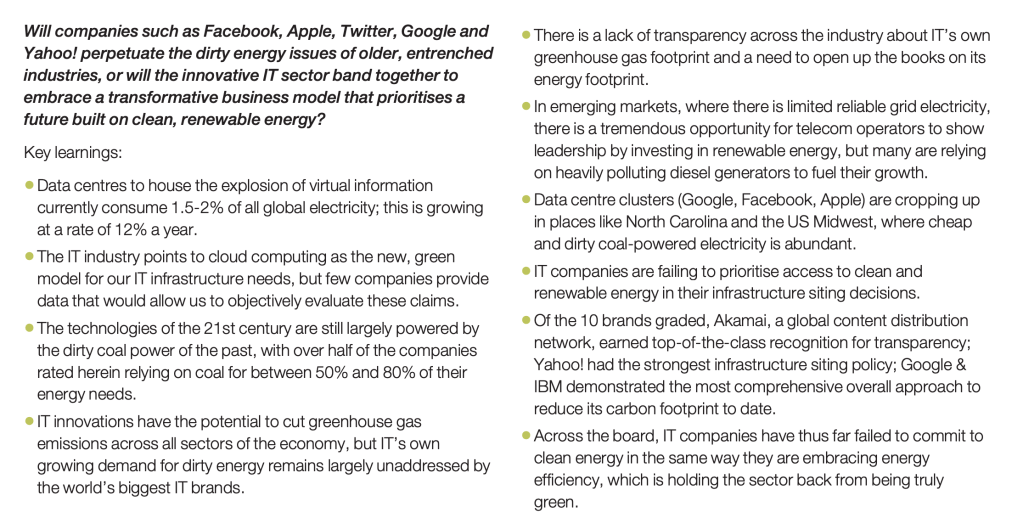
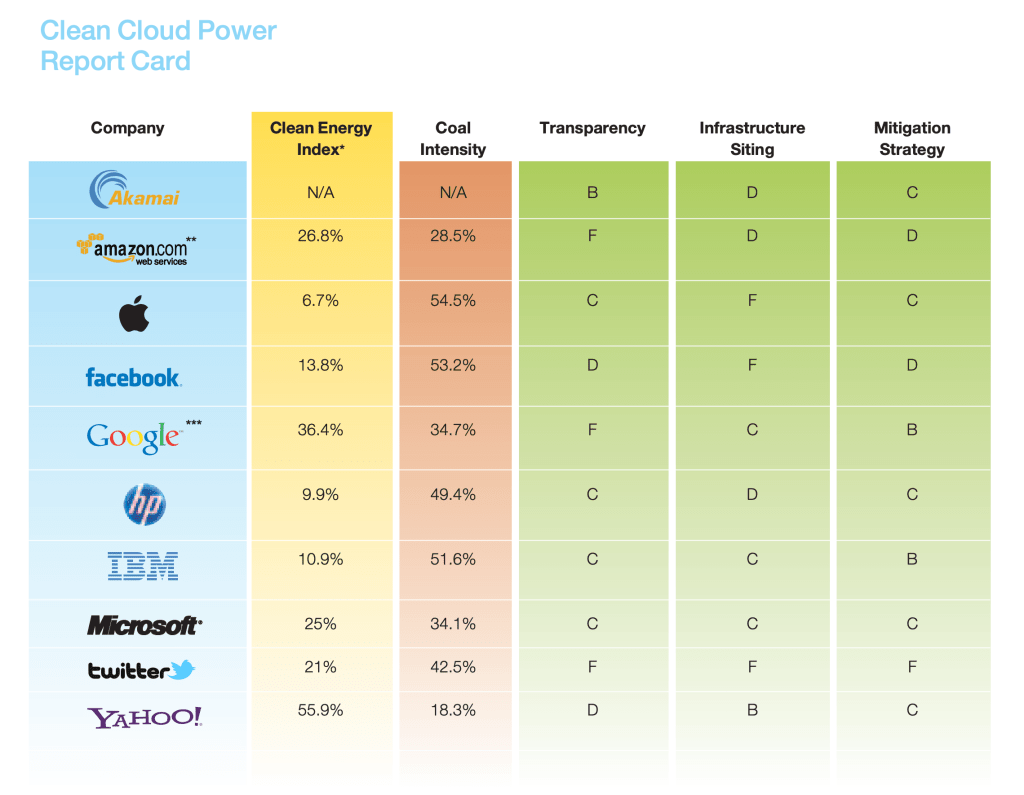
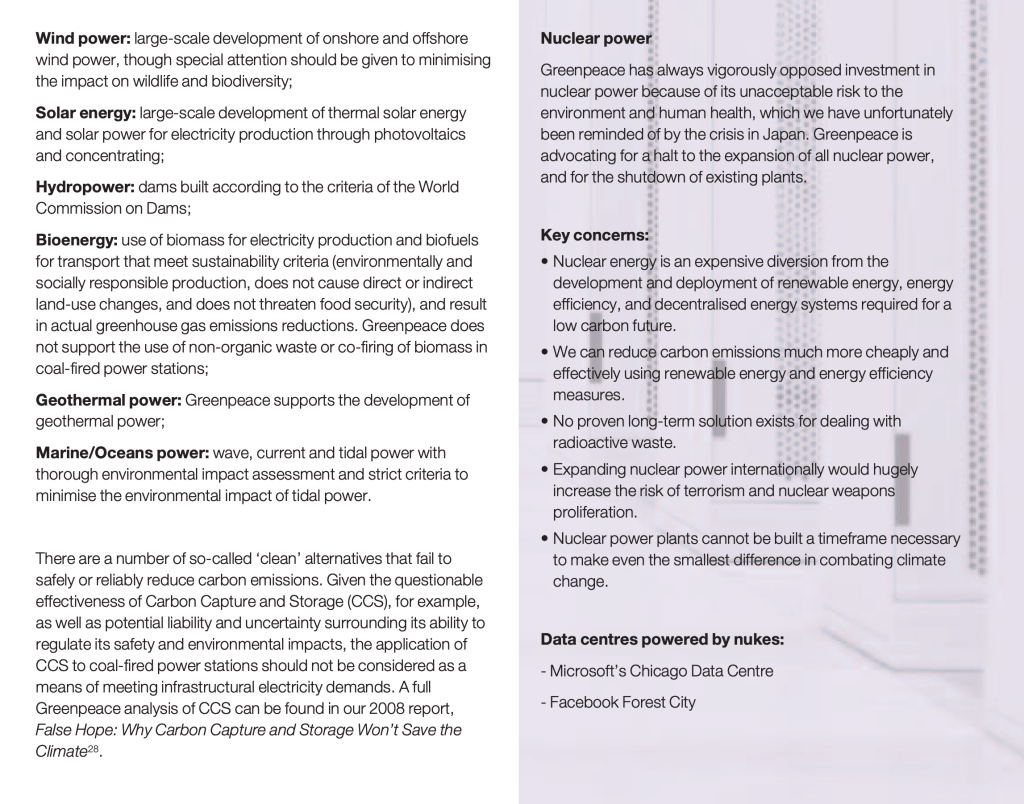
Greenpeace’s “How dirty is your data?” report
Creatives and the digital world
- “Look at the size of your designs – you want your designs to look beautiful on a screen. You also want to mitigate their impact on the environment. The larger the image and file size, the larger the energy consumption. Reducing the size of your design is a small change that cumulatively can have a positive effect on energy consumption
- Look for a green cloud provider – as you work on a design for a client, you will need to share the design with your client as you work on it. Rather than emailing them your designs, use a cloud-based solution for sharing and collaboration, and have a look around to make sure the provider you choose has suitably green credentials. Climate Care tells us that a small business of 100 people or less could cut its carbon footprint by 90% by moving to the cloud.
- Printer-friendly website design – consider the amount of ink your design will use if a user decides to print out a page from your website, for example, white text on a coloured background will use more than dark text on a white background.
- Switch to a greener energy supplier – graphic designers rely on their computers for work and where the energy powering your machines comes from matters. Look for energy providers that are using renewables
- Look at the equipment you use – as graphic designers, you will need to have up to date computing equipment to run resource-heavy programmes. However, there is a carbon cost to new machinery. A study by The University of Edinburgh found that by increasing the amount of time you use a single computer and monitor from 4 to 6 years, you could save the equivalent of 190kg of carbon emissions. Before throwing away your computer and replacing it, ask yourself if you could upgrade or repair your machine instead.
- Save energy – don’t just turn off electronic devices when you’re not using them: unplug them. This will eliminate what Climate Care calls “vampire power”¹. Plugged in but powered down computers still draw power: 5-2 watts of energy. This energy is totally wasted, so make sure you keep your equipment unplugged unless it needs to be plugged in.”
Source These tips above are extremely important for graphic designers to consider as part of their ethical footprint. For instance, saving energy won’t just benefit the environment, it would enable me to save money running my business when using electrical equipment. This is really making me think about the bigger picture of being a graphic designer and that sustainable practice in this field goes beyond physical materials.
Other things for designers to consider as written by UXDesign:
– Findability: More page loads means more energy used, and so helping users find what they’re looking for with minimal effort is vital. A well-structured navigation with clearly labelled menus, logically categorised information architecture and an easily accessed search function represent some easy wins.
– Optimising loading speed: A base level user expectation is browsers being able to quickly retrieve what you’re looking for. Enabling browser caching, optimising image files and removing unnecessary elements (such as heavy JavaScript, plugins, media and little used features) will not only drastically increase loading speed but also likely lead to an uncluttered and clearer UI.
Sustainable UX
What I particularly love about this idea below, is that it encourages companies to consider their footprint through their daily working outputs. For graphic designers to reduce their footprint and CO2 emissions they first need to measure what is being used. A simple excel grid like below would identify cost, frequency and how to reduce the worst areas:

 jesswhatley.design.blog