
Research
Following on from week 1 – I need to identify what the problem actually is with graphic design’s impact on the environment, so I’m going to explore this in research this week.
Introduction: What is the problem with Graphic Design today?
Greenwashing and ‘recycling logo’ not actually making products 100% recyclable!
“Phrases such as “eco-friendly”, “ethically made”, and “non-toxic”, alongside bold advertising claims and eco power-moves, are thrown about by brands who want you to believe their company is so forward-thinking that their office is carbon-neutral and their team eats only locally-grown organic veg.
Producing paper straws to replace your plastic counterparts, only to tell us that they aren’t actually made from a type of recyclable paper? Greenwashing.
Convincing us that your clothing is made within a “fair supply chain”, but being found to employ unpaid garment workers? Greenwashing.
Telling us your haircare range is “vegan-friendly” while you still test on animals? Greenwashing.
Beyond the twisted truths of greenwashing lie the ethical consequences of falsified claims. By supporting brands who talk the talk but fail to do the work, we risk contributing to environmental damage or exploitation, despite our good intentions.” Source
How did we get here? The history of graphic design materials
The letterpress
Print industry – starting with newspapers and ending with leaflets/flyers/merchandise in the modern day
However, newspapers do use soy inks and vegetable inks: “For example, offset lithographic printing on paper (the method used to print newspapers) can utilize solvent-based or soy-based inks. Since the 1970’s, newspapers have in fact been largely printed with soy-based carbon black ink.” Source
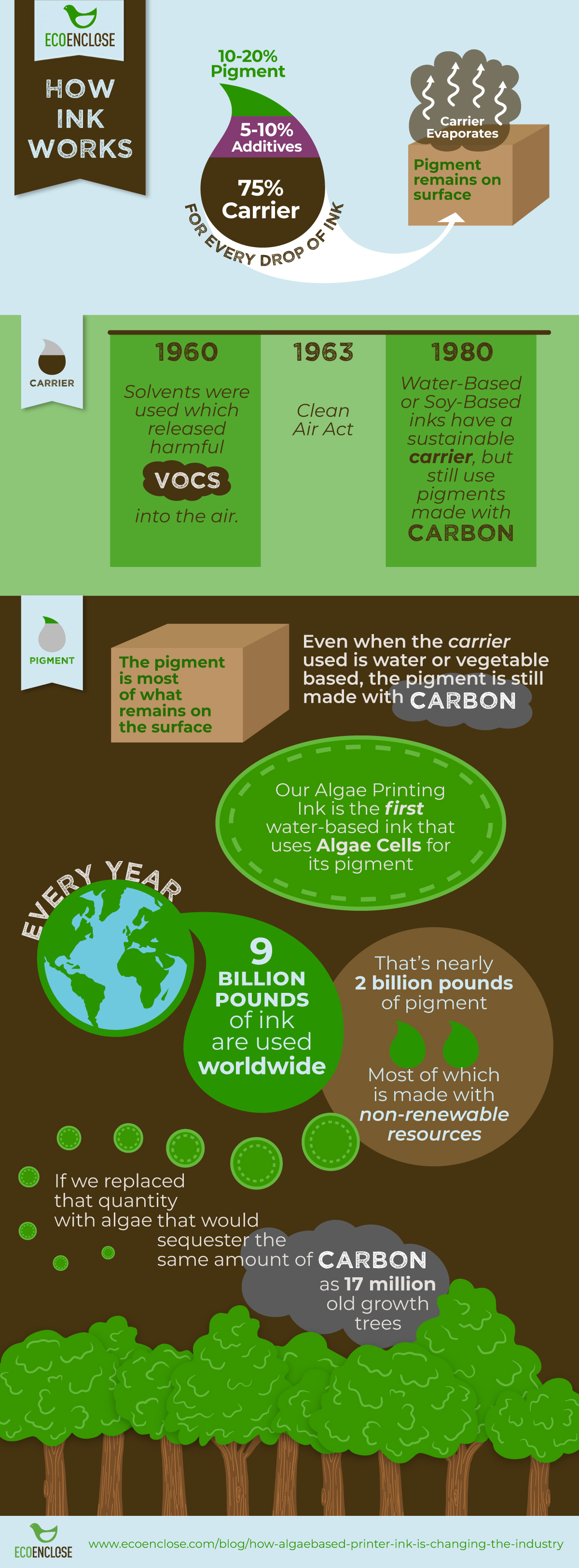
Sustainable typefaces: https://jesswhatley.design.blog/week-2-4/2/
Factors to consider when printing for the environment:
- “Recycle and reuse whenever possible. Recycled printing paper today is more affordable and accessible than ever before. Moreover, there are some eco-friendly papers available today that are completely carbon neutral. Some of the eco-friendly papers can also be produced using renewable energy. Wind power is one of the examples. Regardless of the type of eco-friendly paper you choose, you can be sure to print with the same high quality you expect from the regular paper.
- Go paperless. Of course, it is impossible to stop using paper completely. However, there are still ways to cut down on printing. Numerous modern technologies offer some effective, paperless solutions. For example, some websites and applications fill the niches that were previously occupied by paper. Almost every modern smartphone today has an option to take digital notes. There is even a possibility to scan documents with a mobile device to save a digital copy.
- Double-sided printing. It is one of the easiest ways to reduce the negative impact of printing on the environment. Instead of leaving a blank side on every sheet, you use for printing, you can do printing on both sides, which will cut the number of sheets you are using in half. This strategy will have a positive impact not only on the environment but also on its financial costs.
- Using eco-friendly inks. As has been mentioned above, traditional ink is toxic and harmful to the environment. Therefore, it is better to use such eco-friendly alternatives as vegetable- and soy-based inks. If you are unsure whether the ink manufacturer is eco-friendly, you can always check if the manufacturer is ISO certified. ISO certifications prove that the company is trying to manage its internal and external impact on the environment.
- Print in black and white. Colour is bad as colour inks contain more components in the cartridge.” Source
Packaging
Plastic packaging through the decades, a timeline:
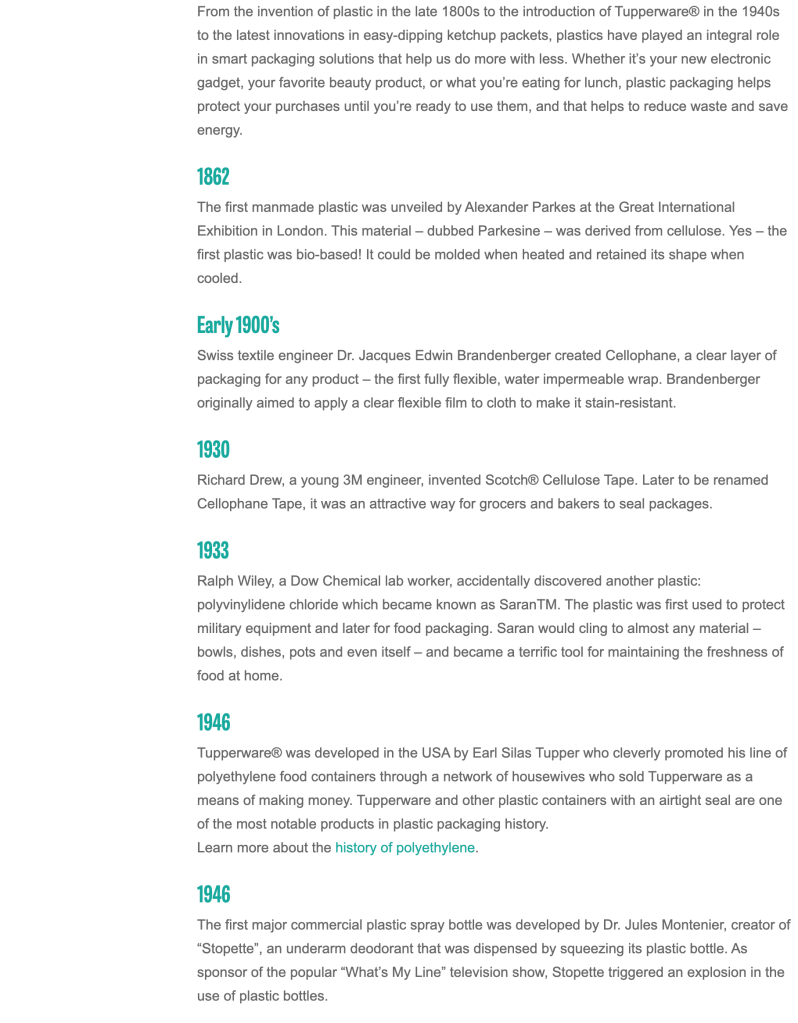
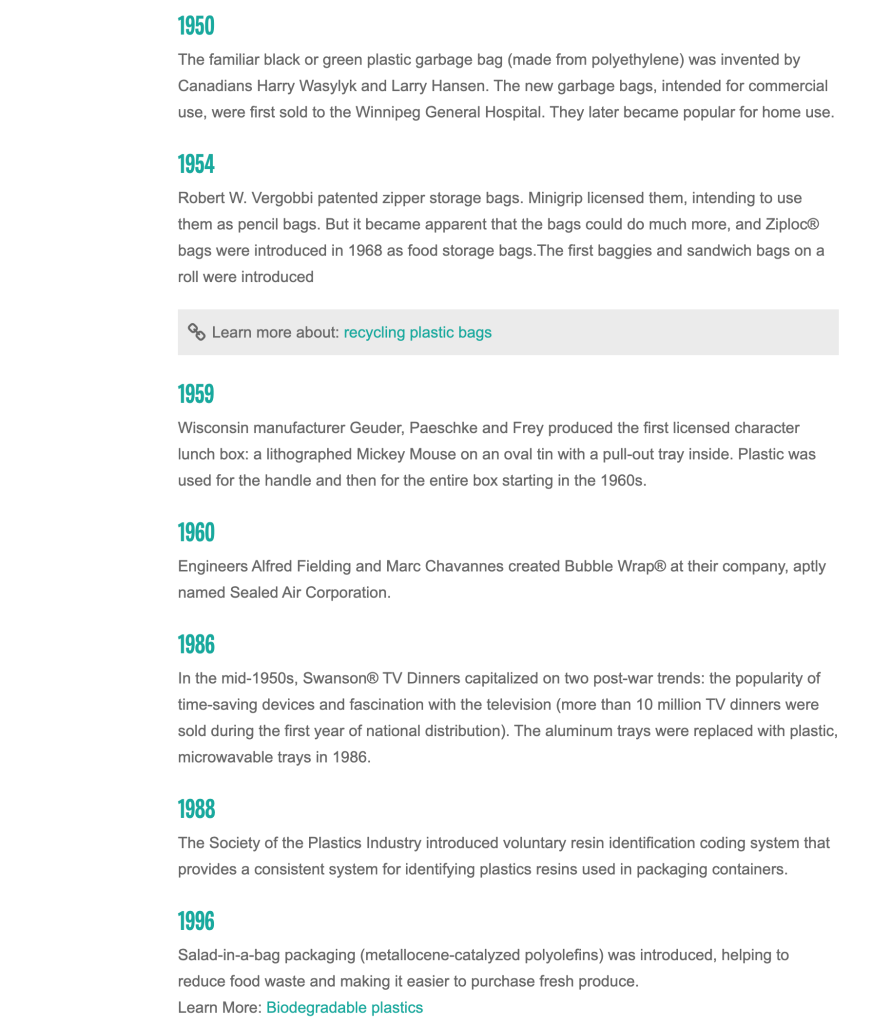

Interesting to see that plastic was initially invented in 1862 by Alexander Parkes, and was bio-based as it was made from cellulose
Plastic as a material, a timeline:

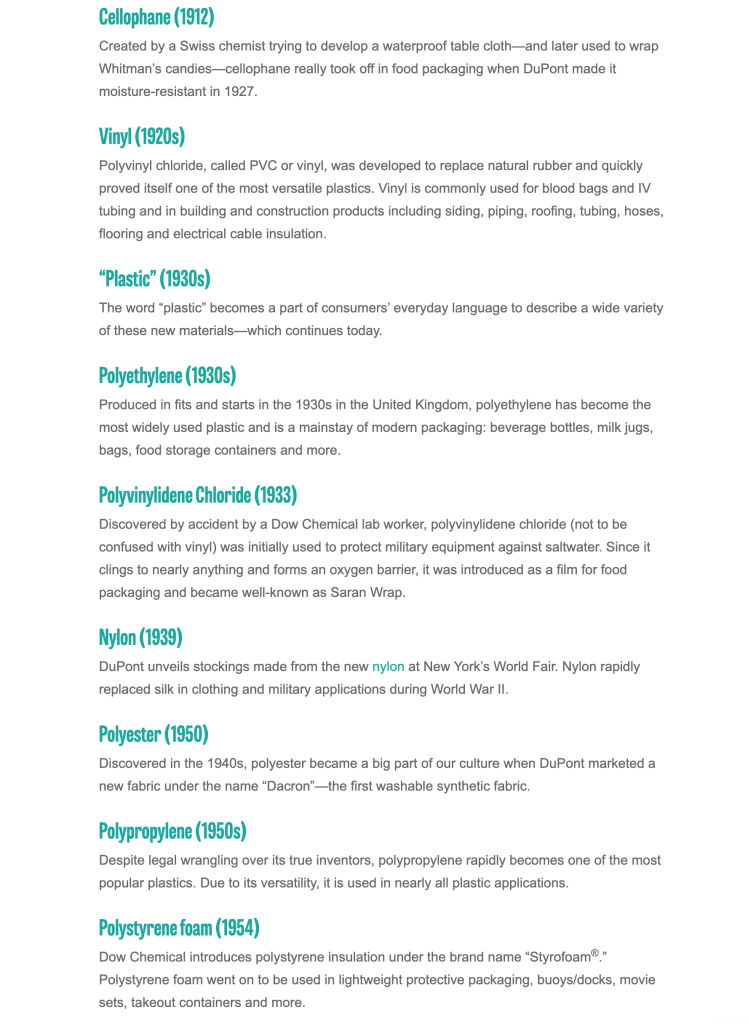
2020 chart of annual plastics produced worldwide 1950-2020
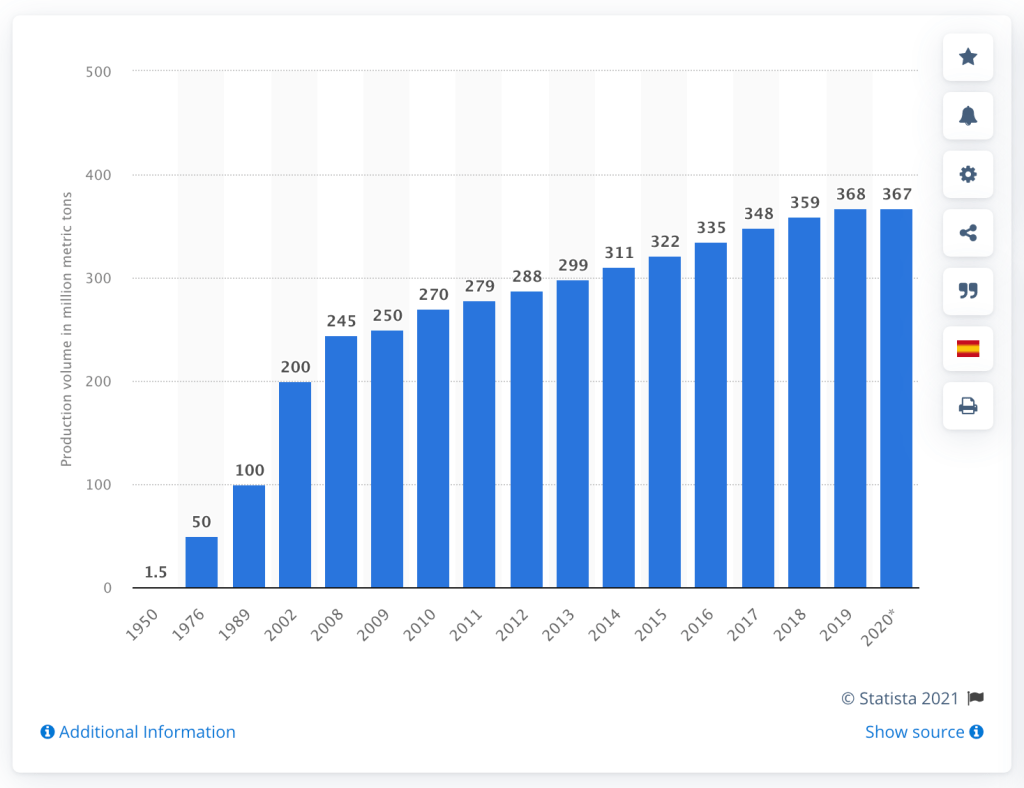
BPF Plastic Packaging
Arguments for plastic as it significantly reduces food waste… Yes but food disintegrates quicker than plastic?: “Beef bought in polystyrene foam trays covered with plastic film will generally last between three and seven days. However if it is vacuum-packed in multilayer plastic, it can be kept for up to 45 days without spoiling.“ https://www.bbc.com/worklife/article/20180705-whats-the-real-price-of-getting-rid-of-plastic-packaging
Covid pandemic is being used as an excuse to use single use plastics: https://www.foodnavigator.com/Article/2020/04/01/Plastic-packaging-Hero-or-villain-in-the-coronavirus-era
Specifically, large corporations are the ones responsible for all of the pollution – think McDonalds: https://thedieline.com/blog/2020/4/8/the-history-of-plastic-is-this-fast-food-to-blame-for-the-single-use-plastic-mess-were-in?
The top three worst brands: https://www.bigissue.com/latest/environment/worlds-worst-plastic-polluters/
Afterlife of materials – which is best?
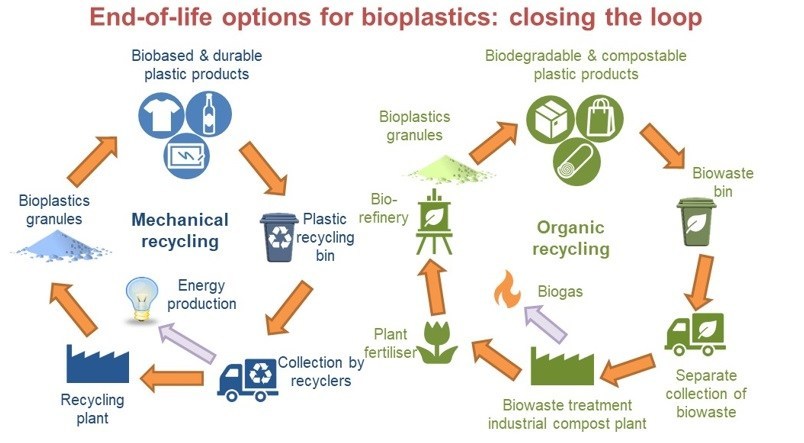
Reusing (not single-use materials as need to be durable)
- Drink bottles
- Tupperware
- Takeout containers
Recycling (to be made into something new after use)
- Glass bottles can be recycled
- Items can be recycled into lower quality material i.e. paper into kitchen roll
Biodegradable/compostable (and is there a difference?)
Yes! There is a difference –
“If we were to rank these terms for which ones are best for the planet and in turn our health, we’d say first look for items that are compostable, recyclable, and lastly biodegradable. Compostable items, if properly disposed of, will break down completely and can them be used to grow more resources. Recyclable items can be turned into raw materials that can then be used to make new things without needing to create completely new resources. And finally, biodegradable options will eventually break down, but we don’t know when and there is no plan to use them for any additional benefit.” Source
- Biodegradable means they will *eventually* break down but not knowing when…
- Compostable means they are guaranteed to begin decomposing pretty soon after disposal
“…only about half of bioplastics are plastics are even biodegradable in the first place. Just because a material is sourced biologically does not necessarily mean it will break down in the natural environmental and many well-publicised bioplastics, such as the biosourced PET used in Coca-Cola’s PlantBottle, are not biodegradable.” Source
- Coca Cola will be a great example of a bad company to look into when I begin my brand archive…
“Compostable packaging is developed to break down within 6 – 12 weeks in optimal conditions (composting at home or industrial facilities). Good quality compostable packaging is tested, certified and complies with BS EN 13432.” Source
Ethical, sustainable and fairtrade practice
What are the differences and what does it mean?
- Ethical
- Sustainable
- Fairtrade
To be ethical refers to the moral principles of right and wrong, and making eco-conscious decisions in the moment. Ethical practice is “the idea that we are free individuals, able to make our own decisions and take responsibility for our actions“ (Roberts, 2020, p.85). The terminology of sustainability refers to long term environmentally friendly applications, and considers the whole footprint of a product or practice. Fairtrade ensures that trading is done correctly and ensuring that supply chains are offering support systems to those involved. Fairtrade “enables businesses – and through them, consumers – to understand the whole supply chain because it is tracked from producer to buyer” (Fairtrade Foundation, 2021).
In a nutshell, fairtrade ensure that the workers involved at the bottom of the production/supplier chain are cared for and that there is a support system in place.
 jesswhatley.design.blog